
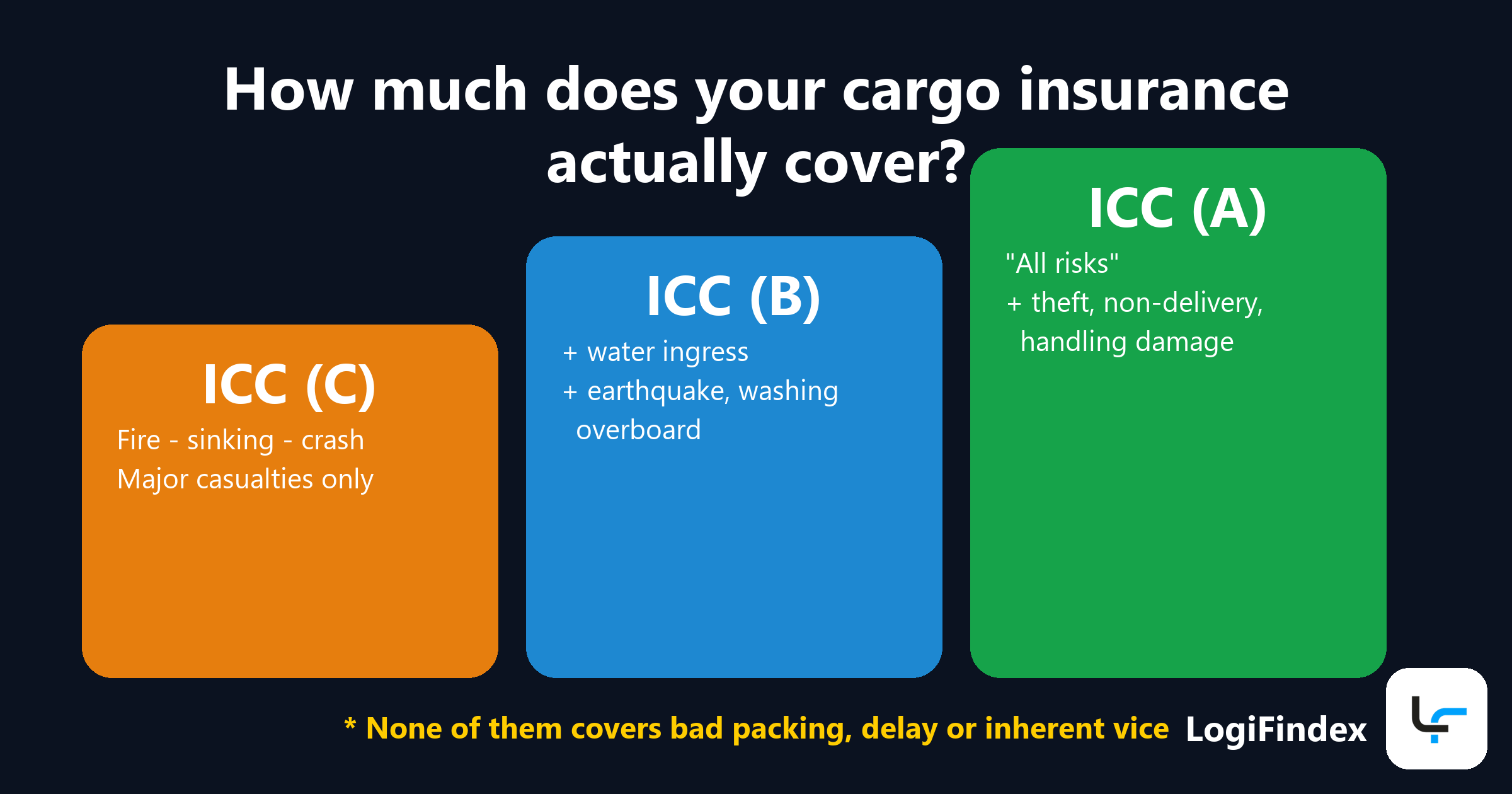
"All risks" does not mean every risk. ICC (A) covers any physical loss that is not expressly excluded; ICC (B) and (C) cover only the perils listed in the clause. None of the three - not even ICC (A) - pays for bad packing, delay, inherent vice, ordinary leakage, war or strikes (the last two are bought separately).
A container goes overboard off Gibraltar. The cargo is insured - the policy says "all risks". The claim is paid.
Same container, same policy. This time it waits three weeks at the port and the textiles inside grow mould from humidity. The claim is rejected.
The difference between those two outcomes is the most misunderstood part of cargo insurance. Knowing which clause you bought is far cheaper than finding out on the day of the loss.
What are the ICC clauses?
The Institute Cargo Clauses are the London market's standard cargo insurance wordings, used worldwide - your Turkish policy almost certainly references them too. Three levels exist:
- ICC (A) - the widest cover, works on an "all risks" basis
- ICC (B) - mid level, named perils
- ICC (C) - the narrowest, named perils only
In the Turkish market you may hear them as genis teminat (A), dar teminat (around C) or tam ziya (total loss only). Whatever the label, ask which ICC clause the policy actually references - the clause number is binding, not the nickname.
There is also a vintage question: the 1982 and 2009 editions circulate side by side. The 2009 revision improved several points in the insured's favour - notably, the packing exclusion was narrowed so that it mainly bites when the packing was done by you or before the insurance attached. Check which year your policy cites.
ICC (C): major casualties only
The narrowest cover. The logic: it pays only when something serious happens to the means of transport itself.
Covered: fire or explosion; the vessel sinking, stranding or capsizing; the road vehicle overturning or derailing; collision; discharge at a port of distress; general average sacrifice and jettison.
Note what is missing: no theft, no wetting, no loss overboard. If your container falls off the ship, ICC (C) does not pay. If the ship sinks, it does.
ICC (C) makes sense for low-value, damage-tolerant bulk cargo - scrap, coal - where the premium saving matches the risk.
ICC (B): the middle road
Adds to (C): earthquake, volcanic eruption, lightning; washing overboard; entry of sea, lake or river water into the vessel, container or place of storage; total loss of a package dropped during loading or unloading.
The critical addition is water ingress. Sea water in your container triggers ICC (B), not ICC (C). But there is still no theft, and malicious damage needs an extra clause.
ICC (A): "all risks" - but not unlimited
ICC (A) works in reverse: it covers every physical loss that is not excluded. Theft, pilferage, non-delivery, malicious damage, handling damage - all in.
That makes it the default for high-value, stealable or fragile cargo: electronics, textiles, machinery, food, cosmetics. If you choose anything below (A) in those categories, you need a reason.
What NONE of them covers
This is the most important section of this article. The following are excluded even under ICC (A):
- Insufficient packing - including stowage inside the container when that was your job. This is the single biggest reason cargo claims get rejected.
- Inherent vice - fruit rotting, chemicals degrading, metal oxidising on its own.
- Ordinary leakage, wear and tear.
- Delay - even when the delay is caused by an insured peril. Missed season, discounted sale: not covered. The mould example above largely lives here.
- War and strikes - bought separately as Institute War Clauses and Institute Strikes Clauses. On lanes like the Red Sea or the Black Sea this split is real money; see war-risk surcharge.
- Insolvency of the carrier.
Which cargo, which clause?
| Cargo | Suggested | Why |
|---|---|---|
| Electronics, phones, computers | ICC (A) | High theft risk, high unit value |
| Textiles, apparel | ICC (A) | Theft + wetting + staining |
| Machinery, spare parts | ICC (A) | Handling damage, oxidation |
| Food, cold chain | ICC (A) + reefer breakdown clause | Standard clauses exclude cooling failure |
| Furniture, appliances | ICC (A) | Scratch and impact are not named perils |
| Packaged chemicals | ICC (A) or (B) | Depends on packing quality |
| Bulk scrap, coal | ICC (C) | Damage-tolerant, low unit value |
| Used equipment | ICC (B) or (C) | Existing wear is excluded anyway |
Incoterms may be deciding for you
Two terms make insurance contractual: CIF requires the seller to insure at minimum ICC (C); CIP - since Incoterms 2020 - requires minimum ICC (A). If you work from pre-2020 template contracts, check them. In both cases the minimum insured value is 110% of the CIF value - see sum insured.
The cost of under-insuring
Insure below real value and claims are scaled down proportionally. Insure a EUR 100,000 cargo for EUR 60,000, suffer a EUR 20,000 partial loss, and you receive EUR 12,000 - because your insured ratio is 60%.
6 questions before you buy
- Which ICC clause and which year's edition?
- Are war and strikes included or separate?
- What is the deductible?
- When does cover start and end? Standard clauses run warehouse-to-warehouse, but end at the final warehouse or 60 days after discharge at the final port - whichever comes first.
- Are transhipment and intermediate storage covered?
- What does the insured value include? Goods + freight + premium + 10% profit.
Conclusion
Do not choose cargo insurance by comparing premiums. List the three most likely things that could happen to your cargo, then check whether your clause covers those three. For most exporters the answer is ICC (A) - and even ICC (A) leaves packing, delay and inherent vice to your operations, not your insurer. If your cargo does get damaged, the clock starts immediately: read the first 48 hours after cargo damage.
Want freight, insurance and customs quotes for the same shipment at once? Publish a single listing on LogiFindex - insurers quote with the coverage clause and deductible stated up front, so you see what is covered before you buy.
*This article is general information. Policy terms vary by insurer and endorsements; review the full wording with your insurance provider.*