
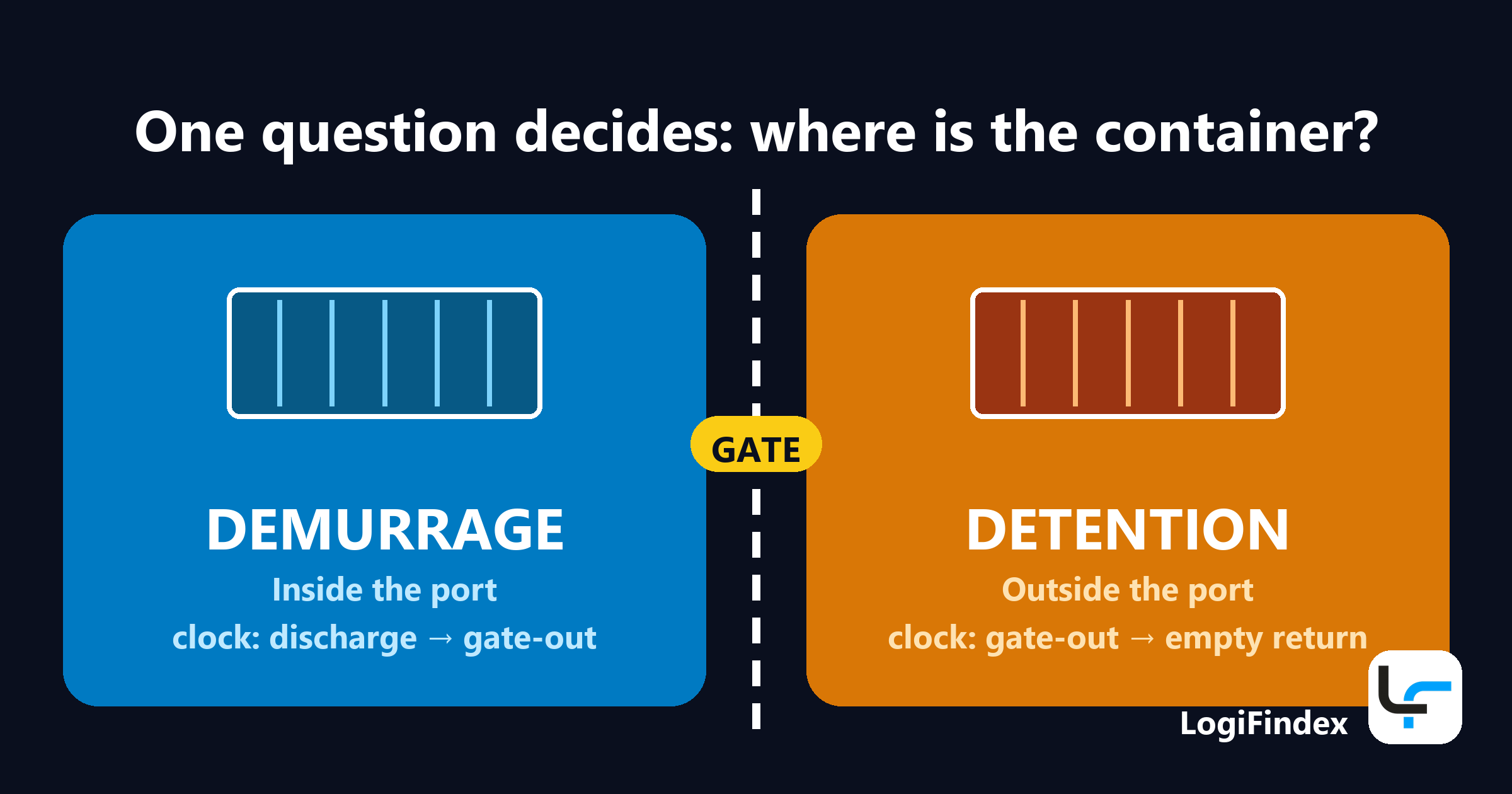
Demurrage is the charge that accrues when a container waits at the port or terminal beyond its free time. Detention accrues after the container leaves the port, until the empty box is returned past its free days. In short: demurrage runs inside the gate, detention outside. Both are almost entirely preventable costs.
An invoice arrives with a line item you did not expect. It says "demurrage", or "detention". Maybe both.
These two items cause more disputes than any other cost on a freight invoice. The reason is simple: both are born from a decision that was not taken before the ship sailed.
This is not a definitions article - it is a prevention article. We will get the definitions out of the way quickly and move on to the real work.
The Difference in Thirty Seconds
One question settles it: where is the container waiting?
| Demurrage | Detention | |
|---|---|---|
| Where is the container | Inside the port / terminal | Outside the port - at your warehouse, on the road |
| Clock starts | After discharge from the vessel | After leaving the port |
| Clock stops | When the container exits the port | When the empty container is returned |
| Triggered by | Customs or pickup delay | Unloading and return delay |
A third item often gets mixed in: storage. Storage is the port's own warehousing fee and is separate from demurrage. The same delay can produce both a demurrage and a storage invoice - one to the carrier, one to the terminal.
How these items relate to the other charges on a freight invoice: Freight Surcharges Reference · For term definitions: Logistics Glossary
Important: these definitions vary by carrier line and country. Some lines invoice the two as a single "combined demurrage & detention" item. Always read the definition in your own contract.
Prevention: 5 Things to Do Before the Ship Sails
1. Lock in customs and inland transport before the vessel departs
This is the most common mistake. Calling a customs broker after the container reaches the port means racing a stopwatch that has already started.
The broker, the document list and the inland truck should be arranged before the vessel sails. On loading day - not arrival day.
2. Prepare documents completely and correctly
Bill of lading, invoice, certificate of origin, HS code. A single missing or incorrect document loses days at customs - and those days are eaten out of your free time.
If you are not sure about your HS code, verify it before the shipment departs: HS Code Lookup
3. Negotiate free time at the quotation stage
A fact very few people know: free time is negotiable.
Common practice in the market is roughly 5-7 days on the terminal side and roughly 5-7 days on container use. But that is a starting point, not a rule.
Three things determine how many days you should ask for:
| Factor | Effect |
|---|---|
| Customs clearance time | Ask for short free time if your documents are ready, longer if uncertain |
| Arrival logistics | Warehouse availability, inland transport plan, unloading capacity |
| Nature of the cargo | Loads needing special equipment can take longer |
Requesting an extension later is expensive and not always granted. Ask while collecting quotes.
4. Account for peak periods
Before holidays, at year-end, around Chinese New Year, and during port congestion or strikes, customs clearance takes longer. For shipments landing in these windows, either increase free time or shift the arrival date.
5. If a long wait is likely, weigh the alternatives
If the cargo is known to be staying at the port for a long time, SOC (your own container) or extended free time options belong on the table. It is not sensible for every load - but when a long dwell is expected, run the numbers.
When Comparing Quotes, Do Not Ignore Free Time
This is the most practical part of the article.
Consider two quotes:
| Quote A | Quote B | |
|---|---|---|
| Freight | €2,300 | €2,450 |
| Free time | 3 days | 7 days |
At first glance A is €150 cheaper.
But if your customs clearance takes 5 days, you pay 2 days of demurrage on A. Daily demurrage rates easily exceed the €150 you saved.
In other words: the cheap quote may be cheap because its free time is short. When you put quotes side by side, add a free-time column next to the freight figure. The decision changes surprisingly often.
If the Invoice Has Already Arrived
- Verify the day count. When free time starts and ends differs by carrier. Counting errors happen.
- Document the cause of the delay. If the delay came from port congestion, a strike or a carrier-side failure, you have grounds to dispute.
- Check the definition in your contract. Whether demurrage and detention are invoiced separately or combined is written there.
- File the dispute without delay. Most carriers have a limited window for disputes.
Keeping your shipment documents in one place speeds this process up: Document Management
Compare quotes with freight, transit time and free time in a single table. Publish your load once on LogiFindex and collect structured quotes from multiple carriers - which quote is genuinely the best usually shows up in the third column.