
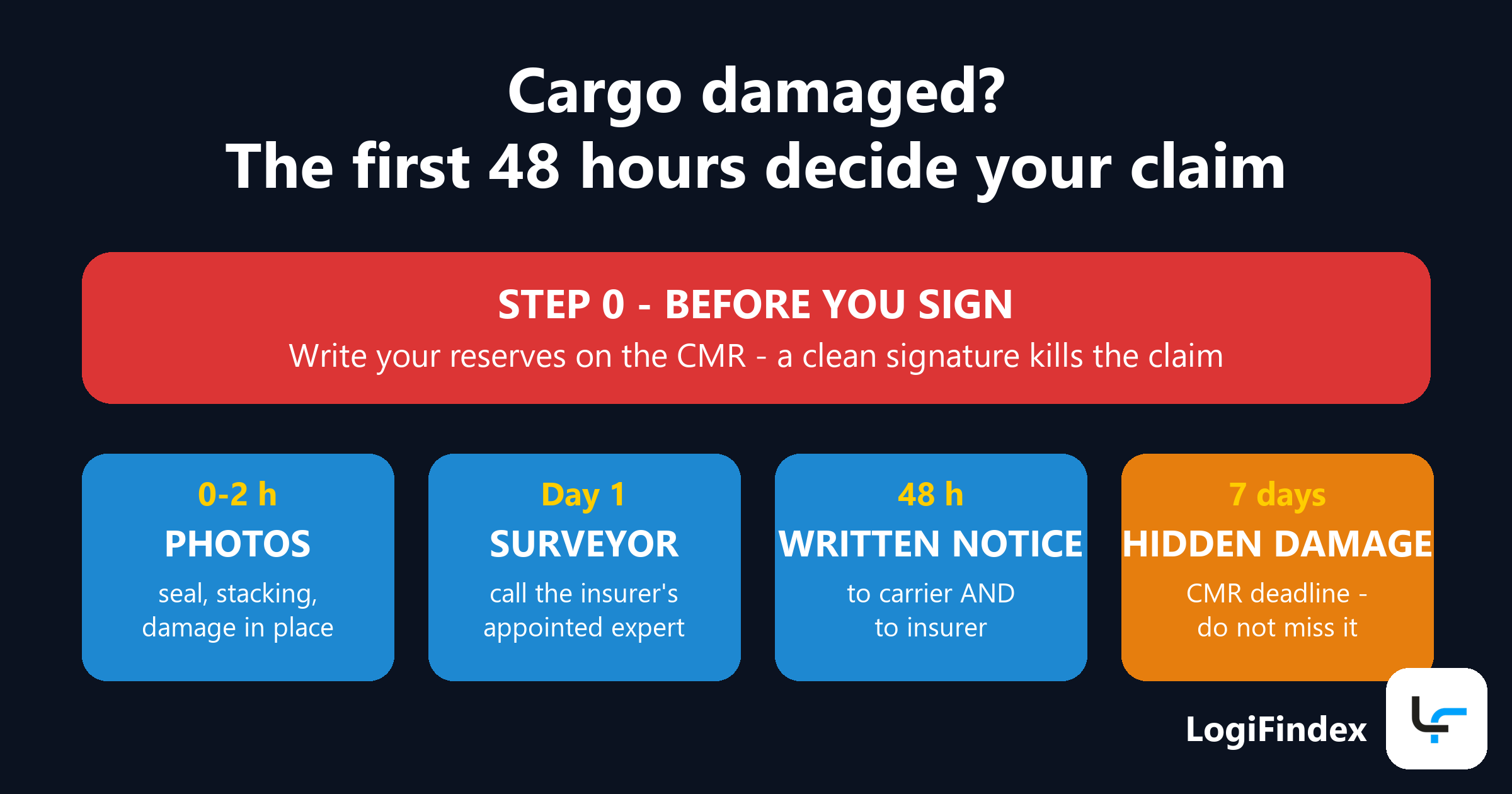
Never sign a clean delivery document for damaged cargo. A signature without reserves creates the legal presumption that the goods arrived in good condition - and shifts the burden of proof onto you. Write what you see on the CMR or delivery note before signing; everything else can be fixed later, that signature cannot.
The truck backs into the warehouse. The forklift unloads, the CMR gets signed, the driver leaves. An hour later someone cuts the stretch film and finds two crushed boxes.
In that scenario your chance of compensation just dropped sharply - not because of the damage, but because of that signed paper.
A cargo damage claim is not paperwork; it is a race. Deadlines are short, they differ by transport mode, and every missed step directly cuts the payout. Here are the six steps for the first 48 hours.
1. Write reserves before accepting delivery
The most critical step and the most skipped one. If damage is visible, note it on box 24 of the CMR, the bill of lading or the delivery receipt. "Damaged" is not enough. Write it like this:
"Pallet no. 3 crushed at left corner, outer carton torn, 2 boxes deformed. Contents not inspected."
Prepare a one-page internal instruction so warehouse staff know exactly what to write before signing.
2. Note the deadlines - they differ by mode
| Mode | Convention | Visible damage | Hidden damage | Delay |
|---|---|---|---|---|
| Road (international) | CMR | Reserves at delivery | 7 days (excl. Sundays/holidays) | 21 days |
| Sea | Hague-Visby | Notice at delivery | 3 days | - |
| Air | Montreal | Notice at delivery | 14 days | 21 days |
Court deadlines run separately: generally 1 year under CMR and at sea, 2 years in air freight.
These deadlines concern your rights against the carrier. Your notice period to the insurer is separate and written in your policy - usually "immediately" or "within 5 days". Do not miss either.
3. Photograph correctly
Ten random phone shots are not enough. Surveyors look for this sequence: the vehicle or container from outside with the plate or container number readable; the seal number close up before breaking; the first frame with doors open showing the stowage; the damaged piece in place before moving; close-ups with an object for scale; the packaging from every angle before discarding.
Keep the packaging. Insufficient packing is excluded under every clause including ICC (A) - see which ICC clause covers what - and the packaging may be the only evidence in your favour. Do not move the goods before the surveyor arrives.
4. Call a surveyor
Above a certain amount an independent survey report is practically mandatory. Call your insurer and ask for their appointed surveyor - a report you commission yourself is not always accepted. The ideal is a joint survey: insurer's surveyor, carrier's representative and yours at the same time, so the carrier cannot later say "we never saw it". Until then: do not sell, destroy or repair the goods.
5. Send written notice to the carrier
A phone call is not notice. Within the deadline, send a written notification - e-mail is fine, get an acknowledgment. Include: shipment reference (CMR/BL/AWB number), delivery date and place, description and estimated amount, a copy of the reserves, photos, and the sentence "all rights and claims reserved".
The carrier's liability is limited - under CMR to 8.33 SDR per kilogram, under Hague-Visby to 666.67 SDR per package or 2 SDR/kg (whichever is higher), in air freight to 26.63 SDR/kg since the 2024 revision. That is usually far below the goods' value, which is why real compensation comes from insurance. But if the carrier was never notified, the insurer loses its recourse and may refuse to pay. Run both tracks together.
6. Build the file in one folder
Policy and certificate; commercial invoice and packing list; BL/CMR/AWB with reserves; photos; survey report; the carrier notice and any reply; and a document proving the amount - repair quote, replacement invoice or discount note.
If general average is declared
If the shipowner declares general average, you owe a contribution even if your own cargo is untouched, and it will not be released until security is provided - an average bond plus an average guarantee from your insurer. Delay here means demurrage; call your insurer the moment you hear the words.
Three common mistakes
"We'll deal with it later." The deadlines are statutory; day 8 of a 7-day window is too late. Selling damaged goods immediately. Salvage value is deducted from the claim and the surveyor sets it - sell first and the insurer applies its own number. Notifying only the insurer. No carrier notice weakens the insurer's recourse, and that bill can land on you.
Conclusion
The process does not run in your favour: deadlines are short, the burden of proof moves fast, and the single most important step happens in the first minute. If you remember one thing: do not sign clean.
Keeping shipment documents in one place makes assembling a claim file a matter of minutes. With LogiFindex Document Studio your CMR, invoice and packing list live in the same shipment folder.
*Deadlines and liability limits above reflect the general framework of international conventions; the applicable contract and jurisdiction can change the outcome. For high-value claims involve legal counsel.*