
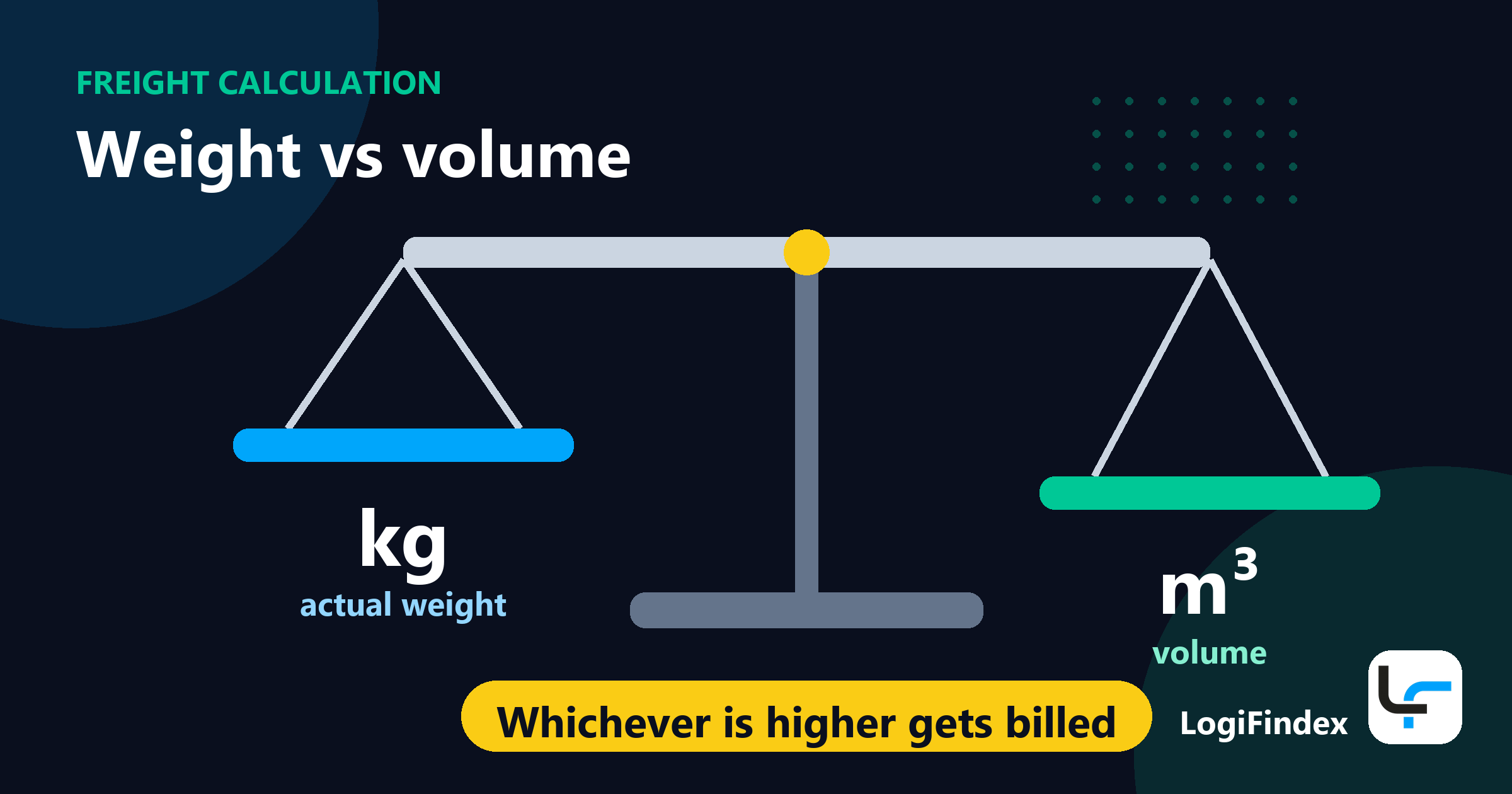
Freight is calculated by comparing the weight of the cargo with the space it occupies, and charging whichever produces the higher cost. In a full container (FCL) the price is per container. In groupage (LCL) cubic metres are compared with tonnes. In air cargo actual weight is compared with volumetric weight. Surcharges such as THC, documentation and fuel are added on top of the base freight.
Search "how is freight calculated" and most articles say the same thing: weight and volume are compared, and the higher one is charged.
True. But none of them take the calculation all the way to the end.
In this article we will work through three scenarios with real numbers, step by step: a full container, a groupage load and an air shipment. By the end you will be able to estimate what you are going to pay.
Note: the figures below illustrate the calculation logic - they are not current market prices. Freight changes weekly with the lane, the season, container availability and backhaul balance. Get quotes for real prices.
The Core Logic of Freight Calculation
In transport, a load consumes two things: space and carrying capacity.
A kilo of feathers and a kilo of iron weigh the same, but the feathers take far more room. That is why a carrier cannot move both at the same price. The solution: look at both the weight and the volume of every load, and charge whichever costs the carrier more.
The principle is identical in every transport mode. Only the conversion ratio changes:
| Transport mode | Conversion measure |
|---|---|
| Sea groupage (LCL) | 1 m³ ≈ 1,000 kg (freight ton) |
| Road groupage | 1 LDM ≈ 1,750 kg |
| Road loose cargo | 1 m³ ≈ 333 kg |
| Air cargo | Volumetric weight = (L × W × H cm) ÷ 6,000 |
A full container (FCL) sits outside this logic - there the price is per container, and how full it is does not change the price.
Example 1 - Full Container (FCL): Istanbul → Hamburg
Cargo: 20-foot container, textiles Scope: port to port, sea freight
FCL maths is relatively simple because the price is per container. Fill it to the roof or half-way - the price is usually the same.
| Item | Amount |
|---|---|
| Base freight (20' container) | 1,400 USD |
| THC - origin port | 180 USD |
| THC - destination port | 190 USD |
| Documentation fee (B/L) | 60 USD |
| ISPS / security | 25 USD |
| Total (port to port) | 1,855 USD |
Three things to watch:
- Base freight is only about 75% of the total. If you collect a quote as just "1,400 dollars", you have not seen the real number. Which items can appear is covered in our freight surcharges reference.
- This price is port to port. Inland transport from your factory to the port, delivery from the destination port to the buyer, customs clearance and duties are not included.
- 20' and 40' are priced differently. And a 40-footer is not twice the price of a 20-footer - usually less. If your cargo does not fit a 20', redo the maths. Dimensions are in the container dimensions table.
Example 2 - Groupage (LCL): 8 Pallets of Textiles
Cargo: 8 pallets Dimensions: each pallet 120 × 100 × 125 cm Actual weight: 4,200 kg total
Step 1: Calculate the volume (CBM)
One pallet: 1.20 × 1.00 × 1.25 = 1.50 m³ 8 pallets: 1.50 × 8 = 12 m³
Pallet dimensions vary by country. Standard sizes are in our pallet dimensions reference.
Step 2: Convert the weight to tonnes
4,200 kg = 4.2 tonnes
Step 3: Compare - which is higher?
| Measure | Value |
|---|---|
| Volume | 12 m³ |
| Weight | 4.2 tonnes |
| Chargeable unit | 12 freight tons (volume is higher) |
This is a volumetric load. Textiles, furniture and packaging - light but bulky goods - usually work out this way. Heavy goods such as iron, ceramics or liquids are charged by weight instead.
Step 4: Price it
| Item | Calculation | Amount |
|---|---|---|
| Base freight | 12 RT × 45 USD | 540 USD |
| Origin local charges | Flat | 210 USD |
| Destination local charges | Flat | 240 USD |
| Documentation fee | Flat | 55 USD |
| Total | 1,045 USD |
🧠 The Critical Comparison
This load is 12 m³. The usable volume of a 20-foot container is roughly 28-30 m³.
So you are filling less than half a container and paying 1,045 USD. In our FCL example, the whole container cost 1,855 USD.
Here is the break-even: once your cargo passes 18-20 m³, groupage cost approaches - then exceeds - a full container. At roughly 14-16 pallets, switching to FCL usually starts to make sense.
The threshold moves with the lane, the season and the LCL unit rate - but when you are near the line, price both options. Most exporters never run this comparison, and overpay because of it.
Example 3 - Air Cargo: 6 Boxes of Electronic Accessories
Cargo: 6 boxes Dimensions: each box 60 × 40 × 50 cm Actual weight: 12 kg per box → 72 kg total
Step 1: Calculate volumetric weight
The air cargo formula: (L × W × H in cm) ÷ 6,000
One box: (60 × 40 × 50) ÷ 6,000 = 120,000 ÷ 6,000 = 20 kg 6 boxes: 20 × 6 = 120 kg volumetric weight
Step 2: Compare
| Measure | Value |
|---|---|
| Actual weight | 72 kg |
| Volumetric weight | 120 kg |
| Chargeable weight | 120 kg |
You ship 72 kilos and pay for 120. A 67% difference.
🧮 Run the numbers for your own cargo: enter your box dimensions and see your volumetric weight in seconds → Volumetric Weight Calculator
Step 3: Price
| Item | Calculation | Amount |
|---|---|---|
| Base freight | 120 kg × 3.80 USD | 456 USD |
| Fuel surcharge | 120 kg × 0.55 USD | 66 USD |
| Security surcharge | 120 kg × 0.20 USD | 24 USD |
| Airline documentation fee | Flat | 45 USD |
| Total | 591 USD |
The lesson: in air cargo, packaging design is money. Shrink the box from 60×40×50 to 50×40×40 and volumetric weight drops from 20 kg to 13.3 kg per box - 80 kg total instead of 120. Roughly 200 USD saved, just by changing the box.
What Moves the Freight Price
Same cargo, same lane, different week - different price. The reasons:
| Factor | Effect |
|---|---|
| Backhaul balance | If the vessel or truck cannot find return cargo, freight rises |
| Lane density | Busy lanes price more competitively |
| Container type and availability | 20', 40', reefer and open top are priced differently |
| Transit time and transshipment | Direct services cost more but carry less risk |
| Season | Year-end, Chinese New Year and harvest seasons move prices |
| Fuel price | Passed through via BAF/LSS-style surcharges |
| Nature of the cargo | Dangerous goods, refrigeration and out-of-gauge sizes add cost |
Most of these are outside your control. But container type, packaging design, transport mode and quote timing are in your hands.
After the Maths: Put Every Quote in the Same Format
You did the calculation and three quotes arrived. Before comparing, convert them to the same format:
- Is the scope the same? One may be port-to-port, another door-to-door. Responsibility boundaries are in our Incoterms reference
- Is THC included? Ask separately for origin and destination
- Is the fuel surcharge included? It can be 10-20% of the total
- How many free days? The gap between 3 and 7 days is demurrage risk
- How long is the quote valid? A 5-day quote and a 30-day quote are not the same product
The lowest-priced quote is usually the most incomplete one.
Do not do the maths yourself - have the quotes arrive comparable. Publish your load once on LogiFindex and collect structured, all-items-included quotes from multiple carriers. No carrier commission; quotes compete anonymously.