
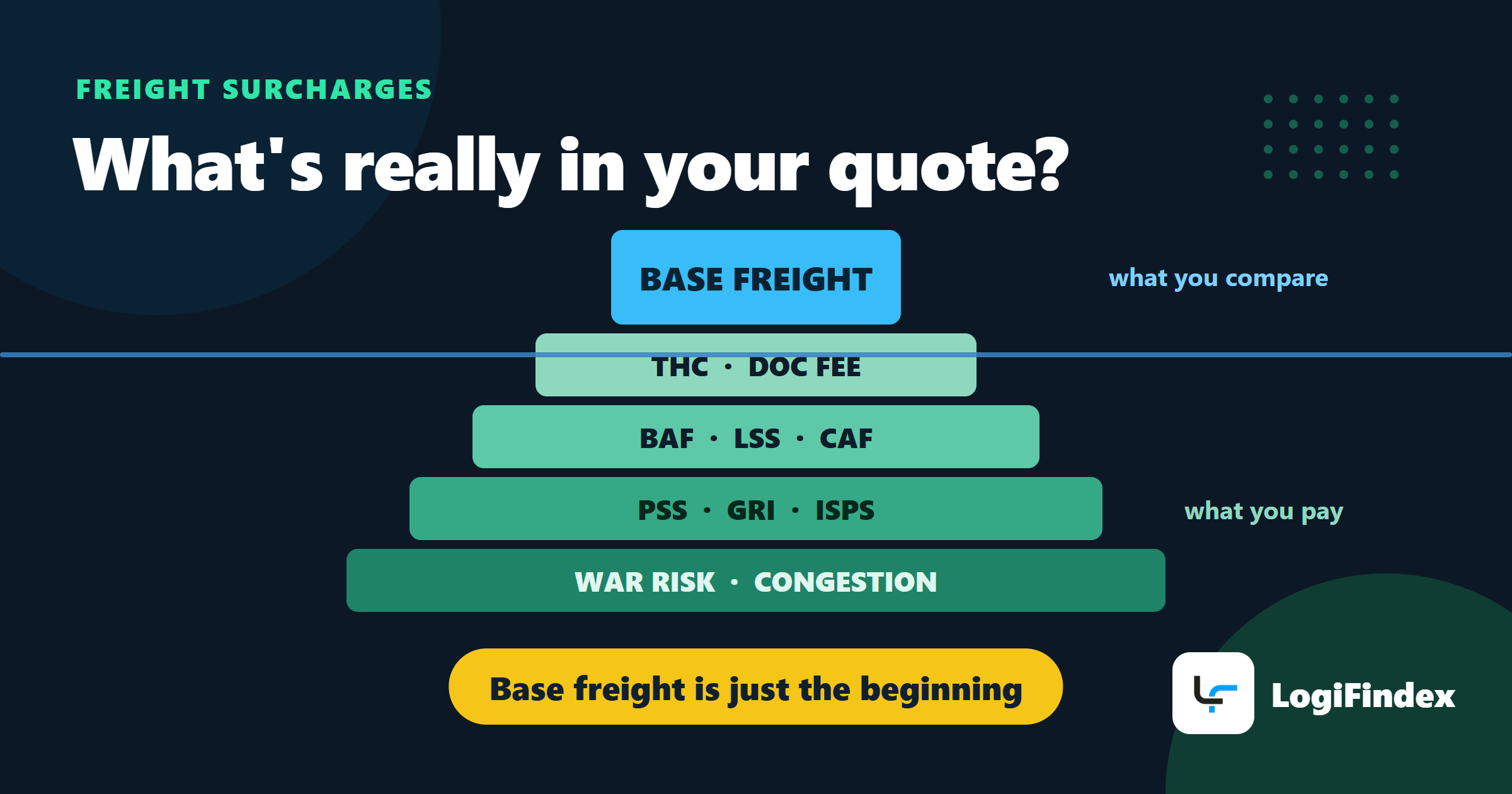
A freight quote is never just the base freight. On top of it come terminal handling (THC), fuel (BAF/LSS), currency (CAF), peak season (PSS), security (ISPS) and documentation fees. Depending on the trade lane and the season, these line items can exceed a quarter of the total cost - which is why comparing base freight alone gives a misleading answer.
You collected three quotes. One is $200 cheaper than the others. When the shipment is done and the final invoice arrives, the "cheap" one turns out to be the most expensive.
The reason is almost always the same: surcharges. Below are the line items that appear most often on freight invoices, what each one actually pays for, and - the part that matters in negotiation - which ones can move and which ones cannot.
The Surcharge Table
| Code | Full name | What it pays for | Negotiable? |
|---|---|---|---|
| THC | Terminal Handling Charge | Container handling at the terminal - charged separately at origin and destination | Amount: no · who pays is set by the Incoterm |
| BAF | Bunker Adjustment Factor | Changes in marine fuel prices | No |
| LSS | Low Sulphur Surcharge | Cost of low-sulphur fuel required by the IMO 2020 rule (0.50% sulphur cap) | No |
| CAF | Currency Adjustment Factor | Exchange-rate fluctuation between quoting and payment currencies | No |
| PSS | Peak Season Surcharge | Temporary charge in high-demand periods | Partly |
| GRI | General Rate Increase | A carrier-announced across-the-board rate increase on a trade lane | By timing |
| ISPS | Security Charge | Port and vessel security measures under the ISPS Code | No |
| Doc fee | Documentation Fee | Issuing the bill of lading and shipment documents | Partly |
| War Risk | War Risk Surcharge | Routes passing through elevated-risk areas | By routing |
| Congestion | Congestion Surcharge | Temporary charge when a port is congested | No |
| D&D | Demurrage & Detention | Keeping the container beyond free time - see below | The free time, not the daily rate |
A note on THC: its amount is set by the terminal and the line - you cannot negotiate it down. What you *can* control is who pays it: the Incoterm allocates origin and destination THC between seller and buyer. "Negotiating THC" in practice means negotiating the Incoterm.
Demurrage & Detention: the Most Expensive Line That Isn't on the Quote
Every container comes with free time - typically 3 to 7 days to pick it up, unload and return it. After that, a daily clock starts, and the tariff is tiered: representative figures run $75-150 per day for the first bracket, $150-300 for the next, and $300+ once you pass roughly day ten. A container stuck for two weeks can cost more than its ocean freight.
The two words are not the same thing:
- Demurrage - the container is still inside the terminal past free time (waiting for customs, documents, payment).
- Detention - the container has left the port with you but hasn't been returned empty in time.
Free time is genuinely negotiable at booking - the daily rate rarely is. Ask for 7+ days if your customs process is slow, and read our demurrage & detention guide before the clock ever starts.
The $200-Cheaper Quote, Line by Line
Back to the story in the first paragraph. Three quotes for an Ambarlı → Hamburg 40'HC - figures are representative, the pattern is not:
| Line | Quote A | Quote B | Quote C |
|---|---|---|---|
| Base ocean freight | $1,150 | $1,580 *(all-in)* | $1,320 |
| THC (origin + destination) | $450 | included | included |
| Documentation | $75 | included | $60 |
| ISPS + LSS | $105 | included | included |
| PSS (applied at sailing) | - | included | $200 |
| Free time | 3 days | 7 days | 5 days |
| Invoice total | $1,780 | $1,580 | $1,580 |
| 2 days demurrage @ $135 (slow customs) | $270 | - | - |
| Real total | $2,050 | $1,580 | $1,580 |
Quote A's headline was $430 cheaper than B's. It finished $470 more expensive - the "extras" added 55% to its base price, and the short free time turned a slow customs day into demurrage. B and C landed on the same invoice, but B's 7 free days made it the safer buy at the same money.
That is the whole argument of this article in one table: the cheapest base freight and the cheapest shipment are different things.
The Road-Freight Counterparts
Surcharges are not a sea-freight specialty. On a road quote - say, Türkiye to Germany - the extras look like this:
| Item | What it pays for | Negotiable? |
|---|---|---|
| Transit permit | Quota-limited permits for countries crossed | No - market-driven when quotas tighten |
| ADR surcharge | Dangerous-goods equipment, driver certification | No |
| Waiting / detention | Truck held at loading, unloading or customs beyond free hours | The free hours, not the rate |
| Fuel adjustment | Diesel price movement between quote and loading | No |
| Ferry / Ro-Ro surcharge | Vessel leg on Ro-Ro-connected routings | By routing |
| Winter surcharge | Chains/winter-tyre season on Alpine transits | Seasonal - by timing |
The logic is identical to the ocean table: fix the scope in writing, and compare grand totals.
Fixed, Variable or Temporary?
This distinction matters in practice, because it tells you which line can still change your price after booking.
- Fixed items - THC, documentation, ISPS. Known at quote time; they do not move afterwards.
- Variable items - BAF, LSS, CAF. Tied to market conditions; many carriers apply the value valid on the sailing date, not the quote date.
- Temporary items - PSS, GRI, congestion. They switch on in certain periods and disappear later. If your schedule is flexible, shifting a booking by a few weeks can avoid them entirely.
The one question to ask on every quote: "Is this price all-in, or will items be added on top?" If the answer is not clear, the quote is not clear. Get the scope in writing.
Making Quotes Comparable: 5 Checks
Before putting quotes from different carriers side by side, equalize five things:
- Scope - is it port-to-port or door-to-door? Inland legs change the total dramatically.
- All line items - compare the grand total of each quote, never the base freight.
- Currency - convert quotes in different currencies to a single one at the same rate.
- Free time - the difference between 3 and 7 free days is your demurrage risk.
- Validity - a quote valid for 5 days and one valid for 30 days are not the same product.
A "cheapest" decision made without these five checks is not a decision - it is the result of incomplete information.
Let the quotes arrive comparable instead. On LogiFindex you publish your load once; quotes come in a structured format with line items separated, so the normalization work is already done. You can also see every common line item explained in our freight charges reference.