
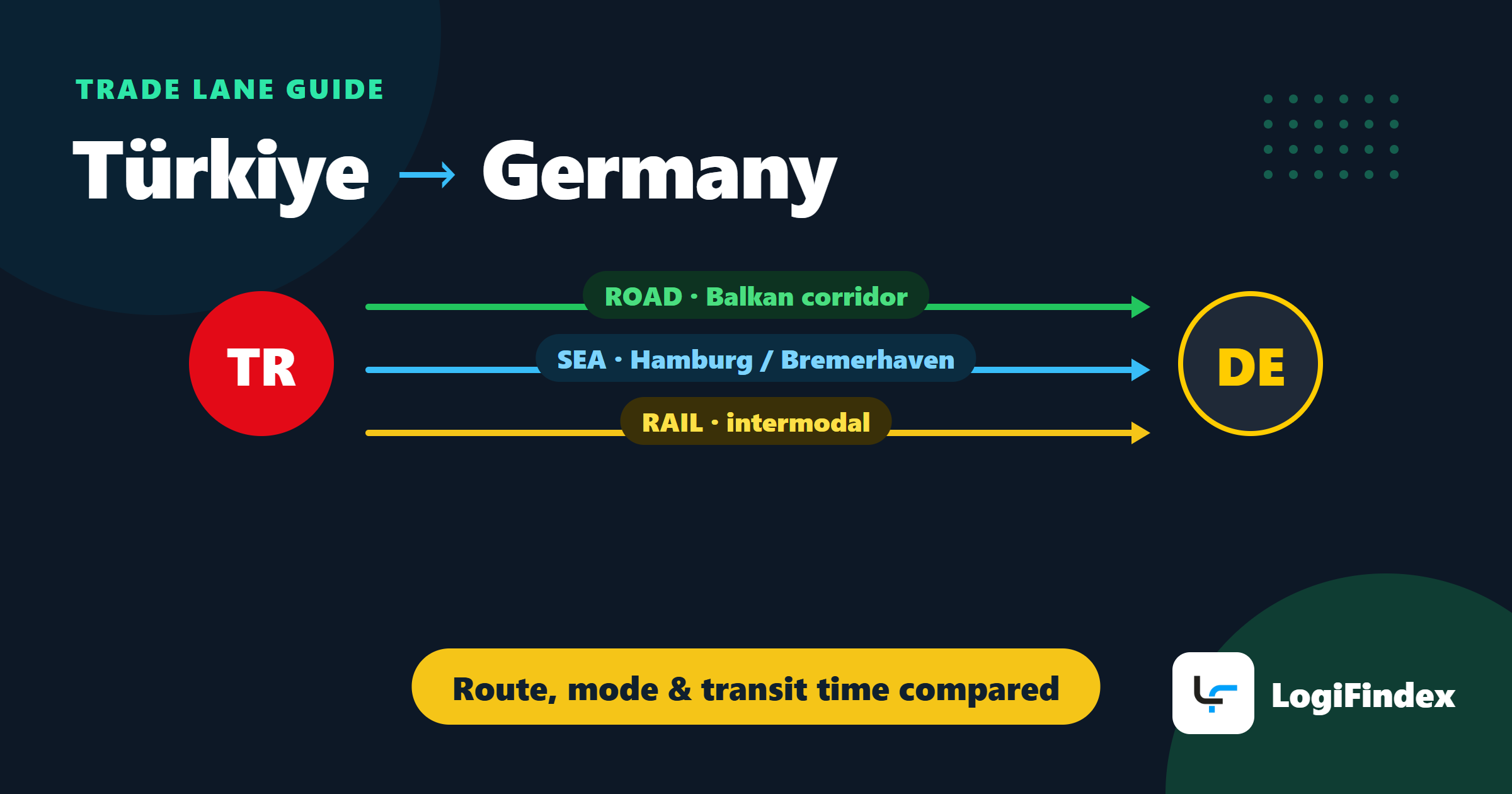
Freight moves from Türkiye to Germany by three main modes: road (the Balkan corridor or Ro-Ro-connected routes), sea (to northern ports such as Hamburg and Bremerhaven) and rail. Road is the fastest, sea is the most economical per volume, and rail sits between the two. The right choice depends on the shipment's urgency, volume and value.
Germany is Türkiye's largest export market. For a shipper that means three things: many carriers compete on this lane, several routings exist, and the price range between quotes is wide.
This guide compares the three modes, the main routings, and which situation calls for which.
The Three Modes at a Glance
| Road | Sea | Rail | |
|---|---|---|---|
| Speed | Fastest | Slowest | Middle |
| Cost | Higher | Lowest per volume | Middle |
| Best for | Urgent, mid-size, high-value cargo | Large volume, flexible schedule | Regular, mid-size flows |
| Door-to-door | Direct | Needs port legs | Needs terminal legs |
| Predictability | Depends on border crossings | High (scheduled) | High (scheduled) |
Transit Times: Typical Ranges by Route
| Route | Typical | Busy season |
|---|---|---|
| Istanbul → Hamburg (road, via Kapıkule) | 5-7 days | 8-12 days |
| Pendik → Trieste → Munich (Ro-Ro + road) | 5-7 days | 7-9 days |
| Ambarlı → Hamburg (sea, FCL) | 14-20 days | 20-26 days |
| Ambarlı → Hamburg (sea, LCL) | 20-30 days | 28-38 days |
These are door-to-door field ranges as of August 2026, including driver rest rules, border waits and customs preparation. For FCL the "busy" column also covers transshipment services; for LCL it includes consolidation waiting time.
Transit times shift with the season, border-gate congestion, port conditions and customs workload. Use this table as a scale - plan on a current quote.
Road: Two Routings
The Balkan corridor. Out through Kapıkule (or Hamzabeyli), then Bulgaria - Serbia - Hungary - Austria - Germany, or the alternative through Bulgaria - Romania - Hungary. It is the most used routing: direct and transshipment-free. Its risk is the border gates - waiting times at Kapıkule and the Balkan crossings rise sharply in busy periods, and that lands directly on your transit time.
The Ro-Ro-connected routing. The trailer sails from Türkiye (Pendik and Yalova are the main departure points) to Trieste in Italy - operators such as DFDS also serve Sète in France - and continues to Germany by road inside the EU.
Why Ro-Ro is popular: it bypasses the land border queues and reduces the need for transit permits, so its schedule is more predictable. The trade-off is cost - it is usually more expensive and tied to the vessel timetable.
About transit permits: international road haulage requires bilateral transit permits for the countries you cross, and these are subject to yearly quotas; ECMT permits are the multilateral alternative. When quotas tighten, road capacity shrinks and prices rise - one of the structural reasons the Ro-Ro option exists. On transits outside the EU (e.g. Serbia), carriers use the TIR carnet or the common transit procedure (NCTS).
Sea
Regular container services connect Turkish ports (Ambarlı, Gebze/İzmit, İzmir, Mersin) with northern European ports - Hamburg and Bremerhaven directly or via Rotterdam connections. Both FCL and LCL (groupage) are available.
When it makes sense: large volume, no urgency, cost as the priority. For a full container, sea is clearly cheaper than road.
Watch out: the ocean price is port-to-port. The inland legs - factory to port, and destination port to the buyer - are priced separately, and free time / demurrage risk is a cost item specific to this mode.
The Cost Items That Don't Show in the Quote
Behind the sentence "sea looks cheap until the line items close the gap" sit these:
Added to the ocean freight:
- Factory → port haulage and destination port → buyer haulage
- THC (terminal handling) - charged separately at origin and destination
- Destination local charges (delivery order fee, ISPS, documentation)
- Demurrage / detention once free time runs out
Added to the road freight:
- Transit permit costs (rising when quotas tighten)
- TIR carnet on non-EU transits
- Extra-day cost of border waiting (long queues put driver + vehicle day-cost into the price)
- Seasonal fuel adjustments
On both modes: customs brokerage (TR export + DE import), cargo insurance, documentation fees.
Compare totals with these items included, not the base freight. The full breakdown is in our freight surcharges guide.
Rail
Block-train and intermodal services between Türkiye and Central Europe have been developing, but schedules and capacity change frequently. If you ship regular volumes, rail is worth pricing - ask for current service options rather than relying on published summaries.
Which Mode Should You Choose?
| Your situation | Suggestion |
|---|---|
| Urgent delivery, mid-size volume | Road |
| Urgent cargo during border congestion | Ro-Ro-connected road |
| Large volume, flexible schedule | Sea (FCL) |
| Small volume, flexible schedule | Sea LCL or road groupage |
| Regular, predictable flow | Price rail as well |
| High value, low volume | Also price air |
The German Side: the Destination Picks the Route
Where in Germany your buyer sits changes the right port and mode:
- Northern Germany (Hamburg, Bremen, Hannover): Hamburg and Bremerhaven are next door - sea freight is strongest here.
- Western Germany (Cologne, Düsseldorf, the Ruhr): services via Rotterdam and Antwerp compete with Hamburg; inland waterway and rail links are strong.
- Southern Germany (Munich, Stuttgart, Nuremberg): the northern ports mean 600-800 km of extra inland haulage. That is why for southern deliveries the Trieste Ro-Ro + road combination often wins on the total - the vessel lands in Italy, and Munich is 530 km away by road.
Simple rule: if the buyer is in Stuttgart, Hamburg is not the "cheap port" - the post-port haulage can eat the difference. Always ask for door-to-door pricing.
Three Scenarios by Sector
Automotive supplier (Bursa → Stuttgart). Production-line deliveries with delay penalties. Choice: road FTL; the Ro-Ro routing in border-congestion periods. The extra cost is trivial next to the risk of stopping a line.
Textiles / apparel (Istanbul → Düsseldorf). 5-10 pallets weekly, steady flow. Choice: road groupage (LTL) - the volume doesn't fill a truck, and regularity earns a rate discount. Hanging garments need a garment-on-hanger trailer, requested explicitly.
Furniture (İnegöl → Berlin). Bulky, low value per kilo, flexible schedule. Choice: 40' High Cube FCL by sea to Hamburg + inland haulage; if the volume is regular, price intermodal too. Paying the road premium makes no sense without urgency.
The Customs Side: A.TR and EUR.1
Because Germany is an EU member, industrial goods within the EU-Türkiye Customs Union move with an A.TR movement certificate, which provides duty-free entry. Agricultural products and coal & steel (ECSC) goods are outside the Customs Union - they use EUR.1 based on origin.
How A.TR works in practice:
- Who issues it: the exporter (or their customs broker/forwarder) prepares it; the chamber of commerce/industry certifies it and customs endorses it at export. The process runs electronically through TOBB's MEDOS system.
- How long it takes: with paperwork ready, chamber certification and the customs visa are usually completed the same day or within 1 business day - it does not hold up the truck.
- Validity: the certificate must be presented to the destination customs office within 4 months of issue.
- If it's missing or wrong: the buyer pays the EU's third-country duty rate for that product (0-4% on many industrial goods, up to 12% on apparel). In most cases the certificate can be issued retrospectively with an "issued retrospectively" endorsement and the duty reclaimed - but that is weeks of paperwork and a dent in the buyer's trust.
The 3 most common mistakes:
- Invoice details (HS code, quantities, consignee) not matching the certificate - it gets rejected at destination.
- Issuing A.TR for goods outside the Customs Union (agriculture, coal & steel) - those need EUR.1.
- Letting the truck depart before the MEDOS approval and customs visa are complete - the certificate then chases the vehicle.
Getting the document right often saves more money than the mode choice itself - a wrong or missing certificate lands directly on your buyer's duty bill, and that becomes your commercial problem.
Incoterms: Who Pays What on a Germany Sale?
| Term | Who pays the freight | Who carries main-carriage risk | Import customs |
|---|---|---|---|
| EXW | Buyer | Buyer | Buyer |
| FCA | Buyer | Buyer | Buyer |
| FOB* | Buyer | Buyer | Buyer |
| CIF* | Seller (incl. insurance) | Buyer | Buyer |
| DAP | Seller | Seller | Buyer |
| DDP | Seller | Seller | Seller |
*FOB and CIF are maritime terms - for road and containerised transport the correct equivalents are FCA, CPT and CIP; writing FOB on a road shipment is nonetheless one of the most common field mistakes.
Practical usage on the Türkiye-Germany lane: on road, FCA (seller's warehouse) and DAP (buyer's address) dominate; on sea, FOB port and CIF destination port. We don't recommend DDP to inexperienced exporters - it creates German import-VAT obligations on the seller's side.
Pre-Departure Document Checklist
- Commercial invoice (English/German, Incoterm stated)
- Packing list
- A.TR (industrial goods) or EUR.1 (agriculture/ECSC)
- CMR consignment note (road) or Bill of Lading (sea)
- Export customs declaration
- Certificate of origin, if required
- Insurance policy (mandatory under CIF/CIP, recommended otherwise)
You can generate all of these free in our Document Studio - the invoice, packing list, CMR and B/L templates are identical to what the platform produces.
Price all modes at once. Publish your load once on LogiFindex and compare road, sea and alternative-routing quotes side by side - with the customs broker quote collected on the same screen, 0% commission.