
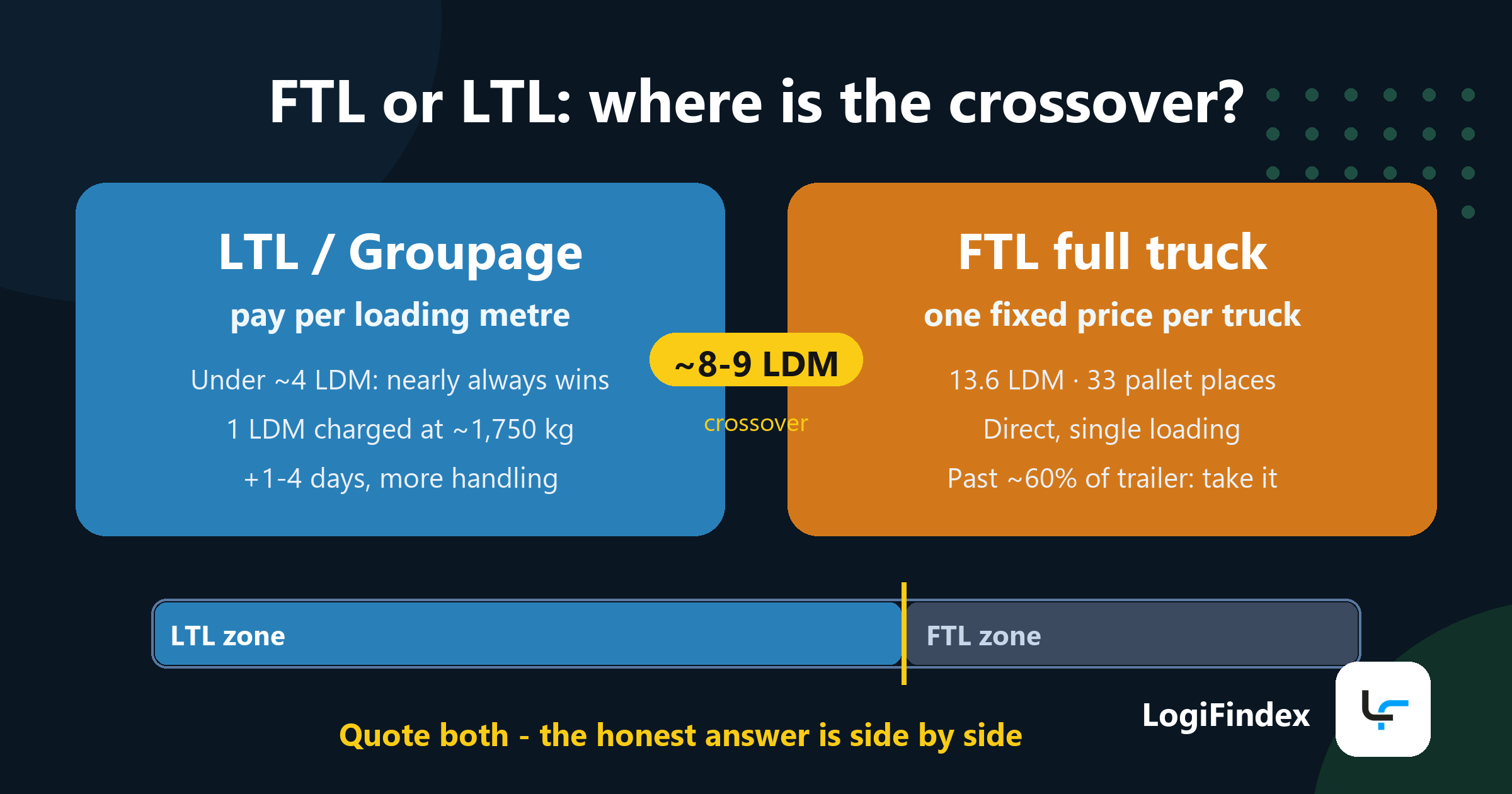
A partial load (LTL/groupage) is cheaper as long as your cargo genuinely occupies a small share of the trailer. The crossover sits at roughly 55-65% of a trailer’s capacity - around 8-9 loading metres or about 20+ pallet places - beyond which a full truck (FTL) usually wins on total cost, and always wins on speed and handling risk. The honest answer is found by quoting both.
Every exporter hits this question at some point: the order has grown, the pallets are stacking up - do I still book groupage, or is it time for my own truck?
Most answer by habit. This guide answers with arithmetic.
The Definitions, Quickly
- FTL (Full Truck Load): the whole vehicle is yours. One loading, one unloading, no transshipment, a fixed price per truck.
- LTL (Less than Truck Load) / partial: your cargo shares the trailer with other shippers’ freight. You pay for the space you use.
- Groupage: the organized form of LTL - a forwarder consolidates many small shipments at a depot, line-hauls the full trailer, then distributes at destination. On Türkiye-EU lanes “partial” in practice almost always means groupage.
How Partial Freight Is Priced: the Loading Metre
The unit that decides your partial price is the loading metre (LDM): one metre of trailer length across the full width. A standard tautliner is about 13.6 LDM and takes 33 europallet places on the floor.
The pricing rule that surprises people: 1 LDM is charged at roughly 1,750 kg, whichever is higher - your real weight or your space converted to weight. Light but bulky cargo pays for its space, dense cargo pays for its weight. If your goods cannot be stacked or top-loaded, you pay for the floor you block, not the cubic metres you fill. (The same logic across all modes is worked through in our freight calculation guide.)
The figures below illustrate the method, not current market rates. Freight changes weekly with lane, season and return-load balance - get live quotes for real numbers.
Worked Example, Three Sizes: Istanbul → Berlin
Assume an illustrative lane rate of €240 per LDM for groupage and €3,200 for a full tautliner. Non-stackable europallets: 3 pallets ≈ 1.2 LDM.
1) 6 pallets, 2 tonnes (e-commerce textile cartons)
- Space: 6 pallets ≈ 2.4 LDM → 2.4 × €240 = €576
- Weight check: 2.4 LDM × 1,750 = 4,200 kg chargeable floor vs 2,000 kg real - space rules, fine.
- FTL alternative: €3,200. Groupage wins by a mile. This is also the classic step up from express parcel for sellers outgrowing the micro-export limits - per-kg cost drops sharply the moment you palletize.
2) 16 pallets, 8 tonnes (machinery parts)
- Space: 16 pallets ≈ 6.4 LDM → 6.4 × €240 = €1,536
- FTL alternative: €3,200 - still double. On price, groupage wins.
- But now the soft factors bite: your 16 pallets get handled at a consolidation depot, ride with strangers’ cargo, possibly wait for the trailer to fill. If the buyer has a delivery window or the parts feed a production line, many shippers take the €3,200 anyway - and past this size, a dedicated partial (your cargo, direct truck, shared only by agreement) is worth requesting as a third quote.
3) 30 pallets, 18 tonnes (furniture)
- Space: 30 pallets ≈ 12 LDM → 12 × €240 = €2,880
- FTL alternative: €3,200 - a €320 gap, before groupage’s slower transit and double handling.
- Take the full truck. You are paying 90% of an FTL for 88% of the trailer plus other people’s schedule. This is the crossover in action.
Rule of thumb: past roughly 8-9 LDM (about 20+ pallet places, 55-65% of the trailer), always price an FTL - it usually wins outright. Below 4 LDM, groupage nearly always wins. In between is exactly the zone where you should quote both.
What the Price Does Not Show
| FTL | Groupage | |
|---|---|---|
| Transit time | Direct, fastest | +1-4 days (consolidation and distribution) |
| Handling | Loaded once | Forklifted at each depot |
| Damage/loss risk | Lowest | Higher - more touches, mixed cargo |
| Schedule control | Yours | The consolidator’s |
| Tracking granularity | Vehicle-level | Depot-scan level |
Higher handling also means the paper trail matters more: reservations on the CMR at delivery, and the first 48 hours after damage, decide whether a groupage claim succeeds.
When FTL Regardless of the Math
- Deadline is contractual (production line, retail slot, penalty clauses)
- Cargo is fragile, high-value or theft-attractive - fewer touches, sealed trailer
- ADR dangerous goods, temperature control or hanging garments - consolidators often exclude or surcharge them
- Non-stackable and an odd footprint - you pay for blocked floor anyway, so the groupage discount evaporates
When LTL Regardless of the Math
- Volume simply is not there (under ~4 LDM) and dates are flexible
- Regular weekly flow - steady groupage volume earns contract discounts
- Testing a new market with small orders
Conclusion: It Is a Calculation, Not a Habit
Convert your cargo to loading metres, apply the 1,750 kg rule, and compare the real crossover for your lane. The spread between groupage quotes on the same load is wide, and the FTL/dedicated-partial line moves with the season - which is why the only reliable method is pricing both at once.
Publish your load once on LogiFindex and receive partial and full-truck quotes side by side - same cargo, same screen, 0% commission. The math does itself.