
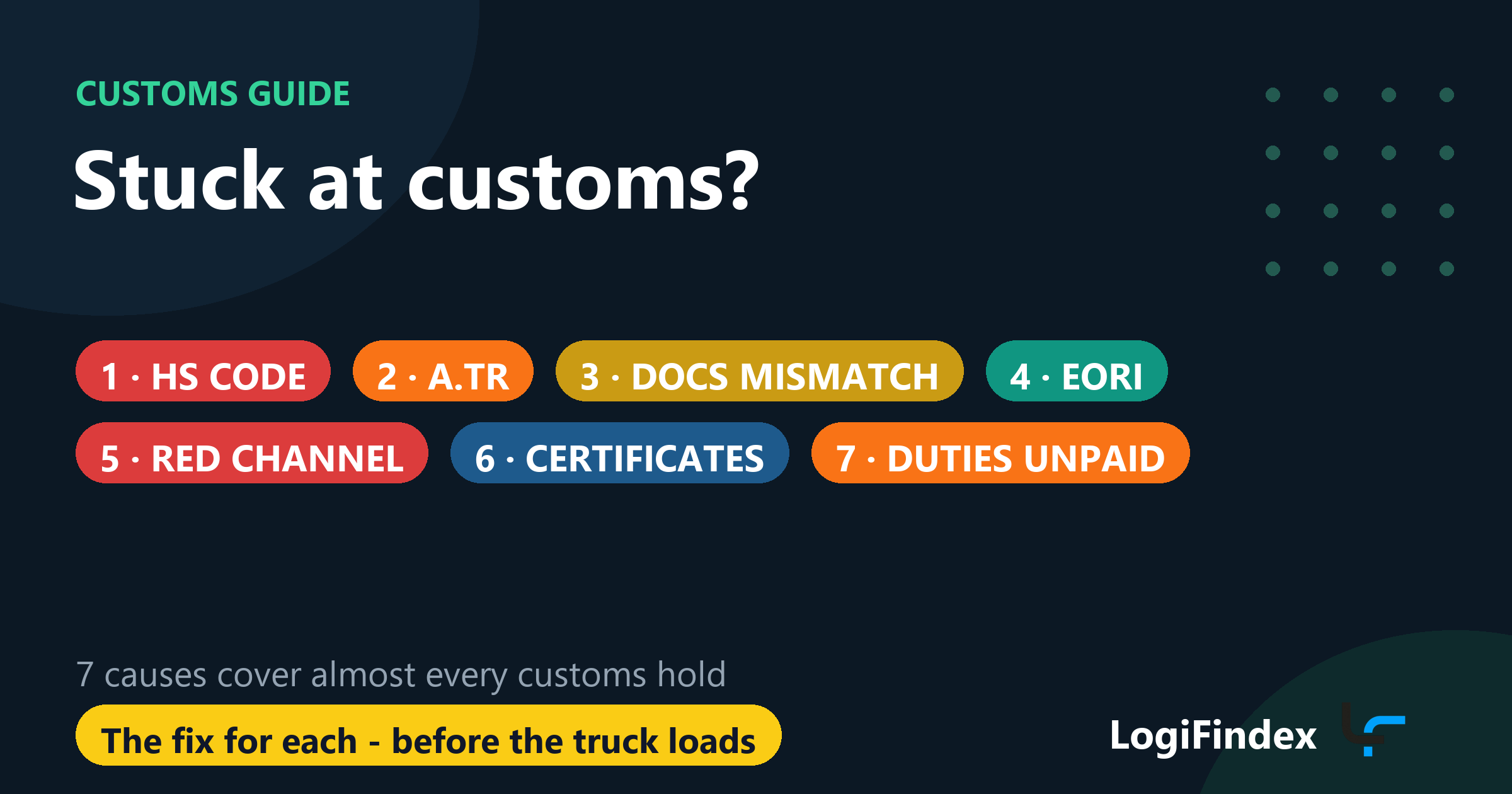
Shipments rarely get stuck at customs for exotic reasons. Seven causes cover the overwhelming majority: a disputed HS code, a missing or faulty A.TR / EUR.1, documents that contradict each other, a missing EORI number, a red-channel physical inspection, a missing product certificate, and unpaid duties or guarantees. Six of the seven are preventable before the truck ever leaves the factory - this guide gives the fix for each.
"Cargo is at customs" is the sentence every exporter dreads, because it arrives with no estimated release time attached. The good news: customs holds are boringly repetitive. Fix the file, and you fix the wait.
1. The HS Code Does Not Convince the Officer
Every product crosses borders under a tariff code, and that code decides the duty rate, the documents required and the inspection profile. When the declared code looks inconsistent with the invoice description - or suspiciously duty-friendly - the file stops for reclassification, and a reclassification can mean retroactive duty plus penalties.
The fix: classify before you price, not at the border. Use the code your buyer's import broker confirms, keep the technical datasheet that justifies it in the file, and stay consistent across invoice, packing list and declaration. Our free HS code lookup covers every chapter with plain-language notes.
2. The A.TR (or EUR.1) Is Missing, Late or Wrong
For Türkiye-EU trade this is the single most expensive piece of paper to get wrong. Industrial goods circulate duty-free under the Customs Union only with a valid A.TR movement certificate; agricultural and coal-steel products need origin-based EUR.1. No valid certificate at import means the buyer pays third-country duty - and calls you.
The fix: issue the A.TR with the export declaration (electronically via the chamber system), check the stamp and validity window, and put it physically in the driver's folder. The certificate mechanics are walked through in the Türkiye-Germany lane guide.
3. The Documents Contradict Each Other
Invoice says 412 cartons, packing list says 410; CMR shows a gross weight the weighbridge disproves; the consignee's address differs between invoice and transport document. Customs systems and officers both flag inconsistency, because inconsistency is what fraud looks like - even when yours is a typo.
The fix: one source of truth. Generate invoice, packing list and transport documents from the same record instead of retyping them, and have a second pair of eyes reconcile quantities, weights and parties before loading. This is precisely the document set LogiFindex generates from a single shipment record.
4. Nobody Has an EORI Number
EU import clearance requires the importer of record to hold an EORI registration. The classic trap is DDP: the Turkish seller cheerfully agrees to be the importer in the EU, then discovers at the border that it has no EU establishment and no EORI - the shipment waits while a fiscal representative is found.
The fix: confirm whose EORI will appear on the import declaration before the truck loads. The full who-needs-it map, including the DDP trap, is in our EORI guide.
5. The Red Channel: Physical Inspection
Declarations are risk-scored into channels - broadly green (release), yellow/orange (document check) and red (physical inspection). A red hit is not an accusation: new traders, sensitive product groups, inconsistent files and plain randomness all raise the score. But a red channel means unloading, counting, sometimes laboratory sampling - days, not hours.
The fix: you cannot veto the lottery, but you lower your ticket count: clean compliance history, consistent documents, realistic values. And when red comes anyway, speed depends on the broker having the technical file ready - datasheets, catalogues, certificates - the same day, not after a week of emails.
6. A Certificate the Product Category Requires Is Missing
Machinery without a CE declaration of conformity, food without health certificates and lab analyses, textiles missing required labelling, wooden packaging without ISPM-15 heat-treatment marks. The freight documents are perfect; the product file is not. These holds hurt because the missing paper often must be issued back in Türkiye.
The fix: treat product compliance as part of the export file, not the R&D department's distant archive. Ask the buyer's broker for the exact certificate list for your HS code and destination, and courier originals ahead when in doubt. Recent EU changes also moved the goalposts for low-value e-commerce parcels - see the new 3-euro flat duty analysis.
7. Duties, Taxes or Guarantees Are Not Settled
The declaration is fine; the money is not. Import VAT and duty unpaid because the buyer's finance department is slow, a transit guarantee not lodged, a deferment account over its limit. The cargo sits in temporary storage - and storage and demurrage meters run while it does, which is how a payment hiccup becomes a four-figure invoice. The prevention playbook for those meters is in our demurrage guide.
The fix: agree before shipment who pays what, on which account, triggered by which document - and send the buyer the figures (from the duty calculation, not a guess) days before arrival.
The Pattern Behind All Seven
Look back across the list: six of seven causes are created - and therefore preventable - before the truck leaves the factory. Customs holds are not weather; they are file quality. Exporters who standardise their document set see the border mostly as a formality, and the cost difference compounds with every shipment. For the full cost picture beyond duties, see what freight surcharges actually mean.
Put a broker on the file from day one. Post your load on LogiFindex and collect carrier, customs-broker and cargo-insurance offers on one screen - so the people who clear your goods see the file before the border does. Commission: 0%.