
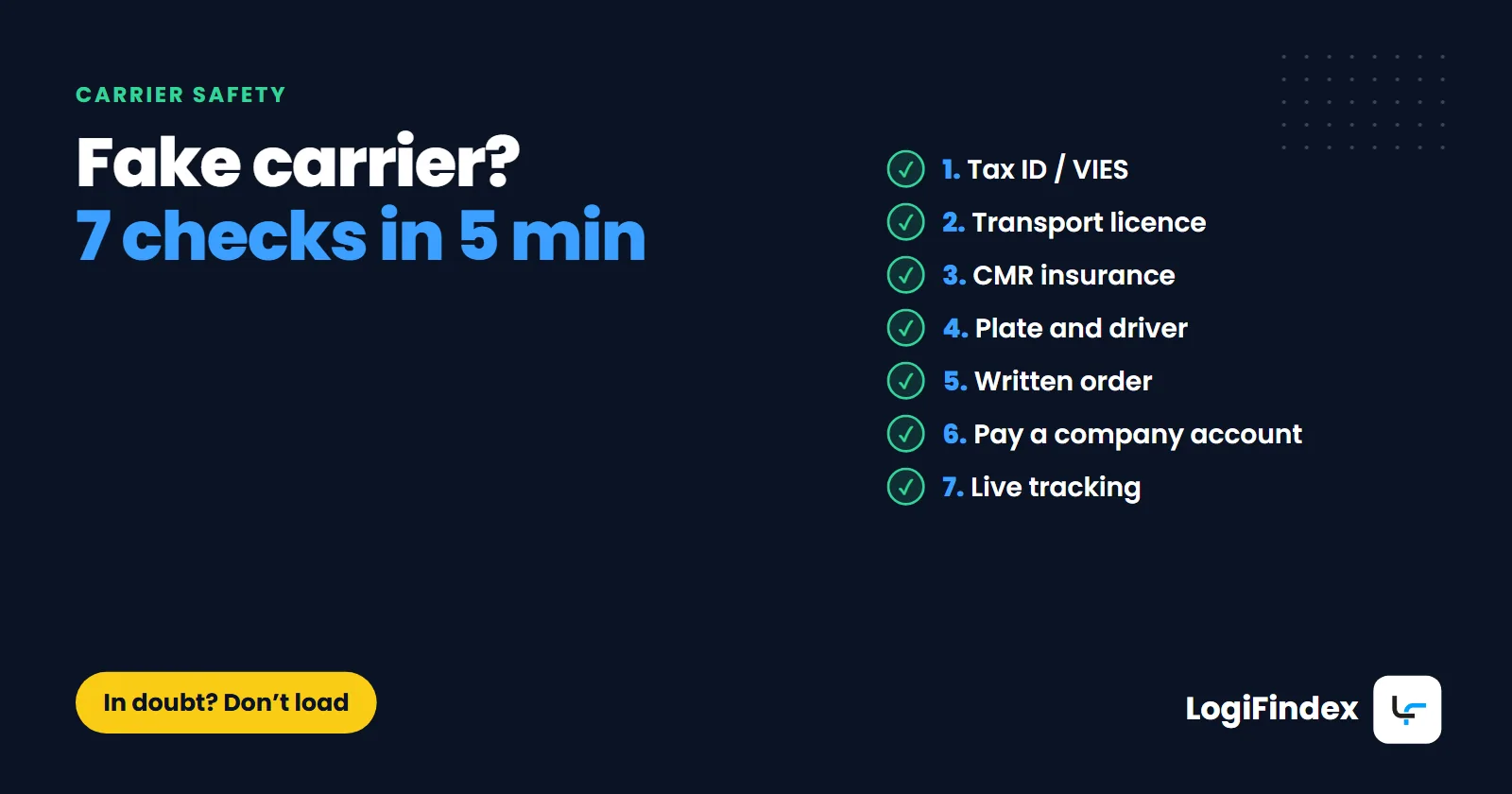
Before you hand a load to a carrier you found online, check seven things in about five minutes: (1) the tax ID or EU VAT number and that the company name matches, (2) the road transport authorization certificate, (3) the CMR liability insurance policy, (4) that the plate, trailer and driver at loading match what was agreed, (5) a written transport order with the carrier’s full legal name, (6) that payment goes to a company account in the same name, and (7) live tracking from loading. A price far below the market is a reason to check harder, not to sign faster.
Most freight goes exactly where it should. But the cases that do not tend to follow the same pattern: a new contact, a price that is too good, pressure to load today, a truck that is not quite the one on the paperwork - and then silence.
None of this needs detective work. It needs a short checklist, done every time, before the doors close.
The Warning Signs
- The price is far below what others quote. Unusually cheap can be legitimate - a return load, an empty truck nearby - but it deserves a second look.
- Contact only through a mobile number or messaging app, no company e-mail domain, no landline, no address you can find.
- Urgency: "the truck leaves in an hour, confirm now".
- The truck that arrives is not the one you were told, or the driver says a different company sent him.
- Payment requested in advance, in full, to a personal account.
The 7 Checks
1. Tax ID and company name
In Türkiye, ask for the tax certificate (vergi levhası) and check it through the Revenue Administration’s (GİB) tax certificate verification using the approval code printed on it. For EU companies, check the VAT number in the European Commission’s VIES service. The name must match the company you are dealing with - exactly.
2. Transport authorization
Commercial road carriers in Türkiye need an authorization certificate (yetki belgesi) from the Ministry of Transport and Infrastructure; freight organizers hold their own type. It can be checked through e-Devlet. A carrier who cannot show one is not a carrier.
3. CMR liability insurance
Ask for the policy, read the insured name, the validity dates and the limit, and confirm it with the insurer. Under the CMR Convention a carrier’s liability is limited to 8.33 SDR per kilogram - often well below the value of your goods, which is why your own cargo insurance matters too. See also carrier liability limits.
4. Plate, trailer and driver
Get the truck plate, trailer plate and driver name in writing before loading. At the dock, compare. If anything differs, stop and call the company on the number you verified - not the one the driver gives you.
5. A written transport order
Pickup, delivery, dates, price and the carrier’s full legal name - in writing. The same name goes in the carrier box of the CMR consignment note. A verbal "OK" on a messaging app is not a contract.
6. Payment to the right account
Pay a company account in the same name as the tax ID, and typically after delivery against the signed CMR. A request to pay a different company, a private person or the full amount up front is the single clearest warning sign.
7. Live tracking from loading
Agree that the driver shares location from the moment the truck leaves your dock. A carrier who refuses, or a location that suddenly goes dark, is your earliest signal.
If something feels wrong: do not load. A delayed shipment costs a day; a lost one can cost the order, the customer and a long claim.
How LogiFindex Helps
- Only companies with a verified tax ID can post listings - Turkish companies by tax ID and tax certificate approved by our team, EU companies through VIES.
- Quotes show whether the company is verified, and offers far below the expected price band are flagged "verify the carrier" by our free Freight Price Check.
- Every job has one shared reference number, written messages, the CMR and documents in one place, and a live tracking link.
Publish your load on LogiFindex and compare quotes from verified companies - 0% commission.