
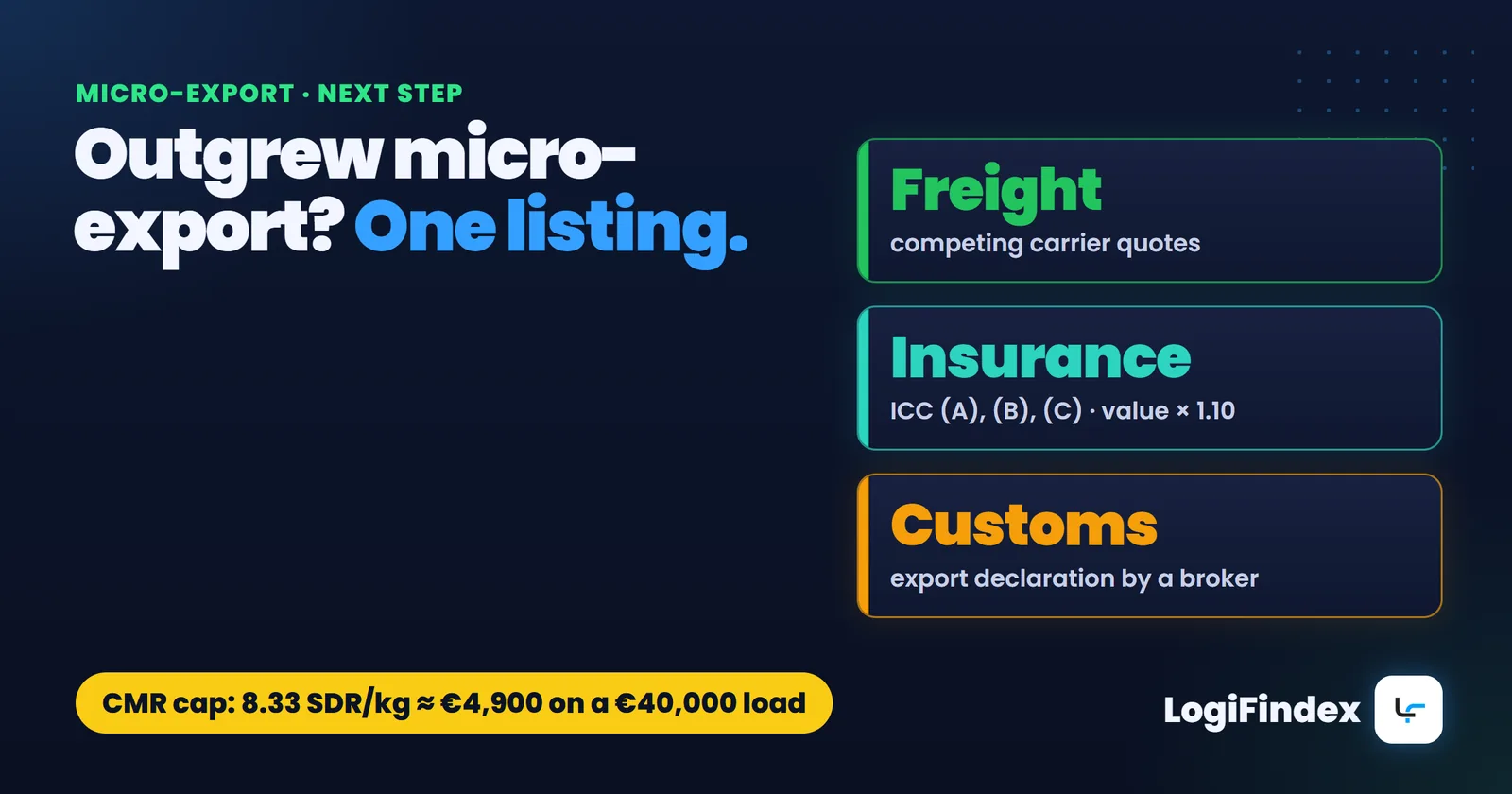
Under Türkiye’s micro-export limit (600 kg gross, €30,000 excluding VAT) an authorized express carrier files the ETGB for you - no customs broker needed. The day a shipment goes over either threshold, or you start sending pallets to B2B buyers, you need three separate things: an export declaration filed by a customs broker, a carrier, and cargo insurance. On LogiFindex you request all three on a single listing, compare competing quotes for each, and accept them separately.
Most micro-exporters do not notice the moment they stop being micro-exporters. The first 700 kg pallet order arrives, the courier says no, and suddenly the questions are new: who files the declaration, who insures the goods, and who carries them?
This guide answers those questions in order. For the limits themselves, see our micro-export limit guide.
Two Worlds: ETGB vs. a Standard Export
| Micro-export (ETGB) | Standard export | |
|---|---|---|
| Limit | Up to 600 kg gross and €30,000 | Above either limit |
| Who files the declaration | The authorized express carrier | A licensed customs broker (or you) |
| Transport | Courier network | Road, sea, air or rail freight |
| Insurance | Courier’s limited liability, optional add-ons | Separate cargo insurance policy |
| Typical buyer | End consumer | Business (B2B) |
The jump is not only about weight. It is about who carries the risk once the goods leave your warehouse.
Step 1: The Export Declaration
Above the limit, the shipment needs a standard export declaration. Which side files it depends on the Incoterm you agreed:
- FCA, CPT, CIP, DAP, DDP: export clearance is the seller’s job - that is you.
- EXW: formally the buyer’s job, but a foreign buyer usually cannot clear exports in Türkiye, which is why EXW often causes trouble in practice. Details are in our Incoterms reference.
Before you ask anyone for a quote, check two things: the correct HS code and the documents your destination requires. Our free HS Code Lookup and AI Compliance Checker cover both; on the listing itself the same compliance insight appears under the HS code field.
Step 2: Cargo Insurance - the Part Most People Skip
Here is the uncomfortable fact: a road carrier’s liability is capped. Under the CMR Convention, which governs international road transport, compensation for loss or damage is limited to 8.33 SDR per kilogram of gross weight (Article 23 of the CMR Convention). For light, valuable goods - textiles, electronics, cosmetics - that cap is often a fraction of the invoice value.
A worked example. You ship 500 kg of textiles with an invoice value of €40,000, and the load is lost. The CMR cap is 500 × 8.33 = 4,165 SDR - roughly €4,900 at 2026 exchange rates (1 SDR ≈ €1.17-1.20, see the IMF SDR rates). That is about one-eighth of what you lost. The same shipment insured on ICC (A) at value + 10% is covered up to €44,000.
Cargo insurance closes that gap. The three standard covers:
| Cover | What it means |
|---|---|
| ICC (A) - All Risks | Broadest cover; everything except listed exclusions |
| ICC (B) | Named perils, wider than (C) |
| ICC (C) | Major casualties only (fire, collision, sinking…) |
The insured value is usually the invoice value plus 10% (CIF/CIP + 10%). And if you sell on CIP, Incoterms® 2020 requires you to insure on ICC (A) terms; on CIF the minimum is ICC (C). Clause by clause, see our ICC clauses guide.
Step 3: Doing All Three from One Listing
Collecting three services from three different companies means three rounds of calls, three formats and three deadlines. On LogiFindex the flow is one form:
- Route & date: transport mode, origin, destination, ready date and Incoterm.
- Products: HS code (with the compliance insight), packaging, dimensions and weight.
- Shipment details: total weight is calculated from the products; add cargo value and handling notes.
- Additional services: with Insure, enter the goods value and you instantly see an indicative premium and the insured value (value × 1.10), then choose ICC (A), (B) or (C). For customs, choose your role (shipper/exporter or consignee/importer), whether you handle it yourself or want quotes from customs brokers, and which side: export, import or transit (T1).
- Review & publish: one summary, one click.
Carriers, insurers and customs brokers then send competing quotes. You compare each service on its own terms - price, transit time and carrier track record for freight; premium, cover and deductible for insurance; scope, fee and required documents for customs - and accept each service separately. The indicative premium is for orientation only; the final premium is the one in the insurer’s quote.
The Paperwork Does Not Disappear - It Gets Organized
You will still need a commercial invoice, a packing list and transport documents. Producing them from one record avoids the classic mismatch between invoice, packing list and declaration - one of the most common reasons goods wait at customs. Our Document Studio generates these templates for free.
Outgrowing micro-export? Publish your first standard shipment on LogiFindex and collect freight, cargo insurance and customs broker quotes on the same screen. 0% commission.