
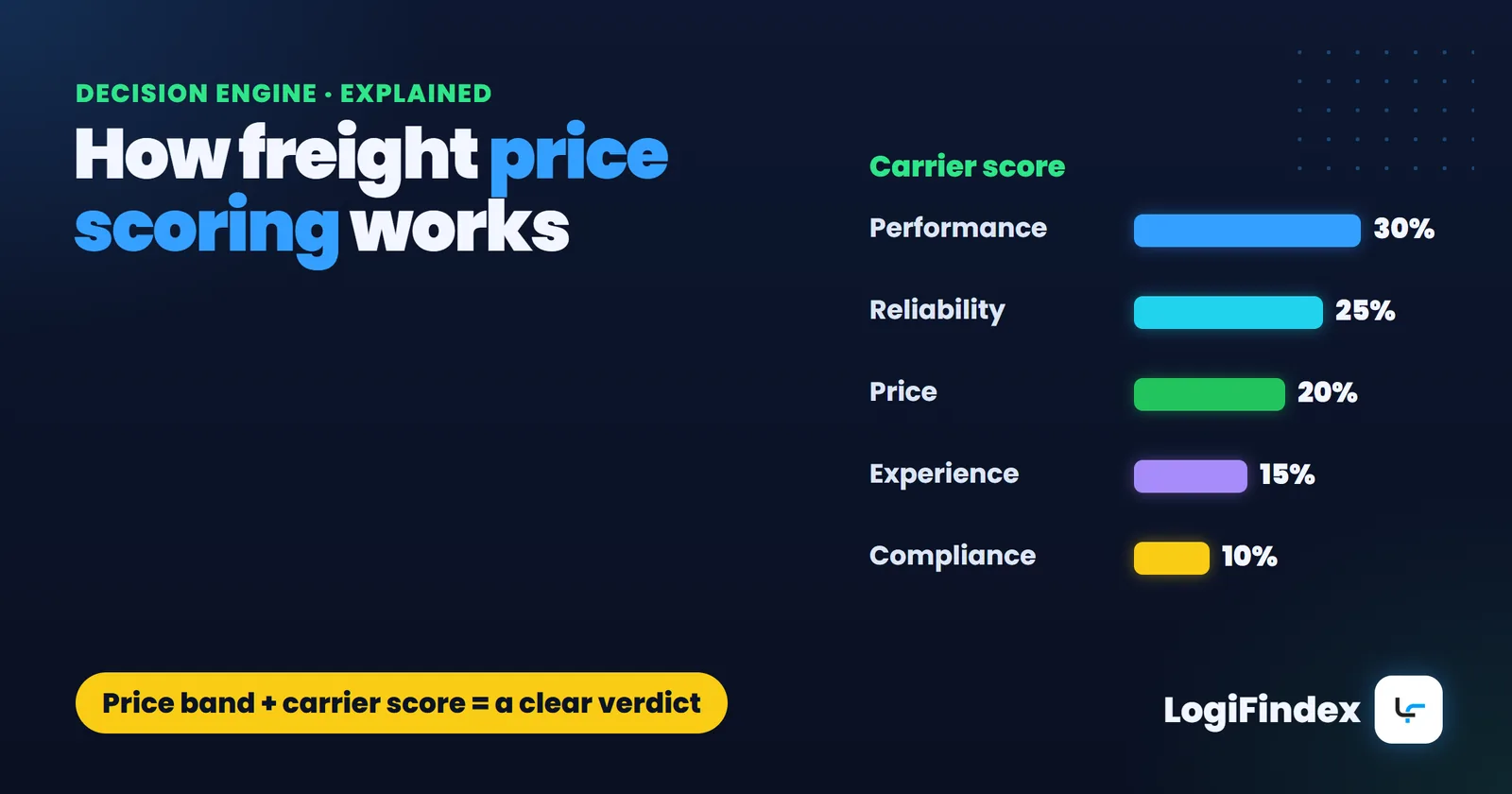
LogiFindex checks every road freight quote in two layers. First, the price is placed against an indicative price band calculated from lane rate tables for the transport mode, adjusted for season, urgency, equipment and cargo type, and gets a plain verdict: acceptable, negotiate, good price, verify the carrier or manual review. Second, the quote is shown next to the provider’s track record: its average rating and number of reviews from completed jobs (once it has at least three) and its verified documents. No blended score is shown, and the decision stays with the shipper.
"AI-powered pricing" usually means a number you cannot question. We think a freight decision deserves the opposite: a verdict where you can see why, and a track record you can read for yourself. This article explains how the LogiFindex decision engine - what we call Transport Decision Intelligence - actually works.
Why "Cheapest" Is the Wrong Question
Three quotes arrive for the same load: €3,250 with 6 days transit, €3,380 with 4 days from a carrier rated 4.8/5 over 12 jobs, €3,620 with 3 days. The cheapest one misses your delivery date. The most expensive one is fast but may be well above market. The right answer depends on price, time and the carrier’s track record together - and the engine’s job is to put those three side by side, not to blend them into one number.
Layer 1: The Indicative Price Band
For every listing, the engine calculates an expected price range from lane rate tables for the transport mode - road, sea, air and rail each have their own tables. It is not a language model guessing a number: the calculation is a set of explicit rules.
| Input | What it does |
|---|---|
| Lane and distance | Sets the base rate for origin-destination |
| Mode and equipment | Truck type, container type, ULD |
| Season and urgency | Peak periods and express service push the band up |
| Cargo type | Dangerous goods and perishables add multipliers |
| Fuel and surcharges | Added on top as separate line items |
The output is a minimum-maximum band, an estimated transit time and a confidence level. (What the surcharge lines mean is covered in our freight surcharges guide; how base freight itself is built, in the freight cost guide.) Each incoming quote is then placed against that band:
| Where the quote sits | Verdict |
|---|---|
| Inside the band | Acceptable |
| Above the band | Negotiate |
| Slightly below the band | Good price |
| Below the band and 25% or more under the expected price | Verify the carrier - unusually low prices deserve a second look |
| Different currency | Manual review - the engine does not guess exchange rates |
A Worked Example
*Illustrative numbers.* Istanbul → Cologne, 5,000 kg of textiles, delivery needed within 4 days. Say the engine calculates a band of €3,150 – €3,500 with an expected price of €3,320. Five quotes arrive:
| Quote | Transit | Against the band | Verdict | What the verdict does not tell you |
|---|---|---|---|---|
| Carrier B · €3,250 | 6 days | Inside | Acceptable | Misses the 4-day deadline |
| Carrier A · €3,380 | 4 days | Inside | Acceptable | Rated 4.8/5 over 12 jobs - the best fit |
| Carrier C · €3,620 | 3 days | Above | Negotiate | Fast, but you pay for the speed |
| Carrier E · €3,050 | 5 days | Slightly below | Good price | Check the transit time |
| Carrier D · €2,450 | 5 days | 26% under expected | Verify the carrier | Ask why before you accept |
The cheapest quote is the one the engine flags. The best fit - Carrier A - is neither the cheapest nor the fastest: it is the one that meets price, deadline and track record together. The verdict covers the price; the deadline and the track record are on the same screen for you to weigh.
Layer 2: The Provider’s Track Record
Price alone says nothing about whether the truck will arrive. That is why each quote is shown with the provider’s history - but as plain facts, not a blended score:
| What you see | When | Where it comes from |
|---|---|---|
| Average rating and number of reviews | Once the provider has at least three reviews | Ratings shippers give after completed jobs |
| Verified documents | As soon as they are approved | Company documents checked before the provider can quote |
Why three reviews? A single glowing review should not make a new provider look proven, and a single bad one should not sink it. Until there are three, no rating appears on the quote at all - nothing is estimated or filled in.
What a Review Asks
After a delivered shipment the shipper rates each provider on the same listing - carrier, insurer and customs broker separately, because they do not fail in the same way. Each review has an overall rating and questions specific to the service:
| Carrier | Insurer | Customs broker |
|---|---|---|
| Overall rating | Overall rating | Overall rating |
| On-time pickup and delivery | Speed of policy issuance | Speed of clearance |
| Communication | Accuracy of the cover | Accuracy and compliance |
| Professionalism | Communication | Communication |
| Problem solving | Help when an issue comes up | Problem solving |
Ratings are two-way: providers rate the shipper too (for example payment reliability and how clearly the shipment was described). (Why the insurance cover matters as much as the premium is explained in our ICC clauses guide.)
What the Engine Deliberately Does Not Do
- It does not show you a blended score that mixes price, ratings and documents.
- It does not show a rating before a provider has three reviews.
- It does not accept a quote on your behalf.
The System Recommends. You Decide.
The engine shows the band, the verdict and the provider’s track record side by side, and you click accept. Every decision also feeds the data: the price band at quote time, the route and the border situation are recorded with each quote, so the band is calibrated on real market behaviour over time.
The price band is indicative, not a price commitment. Freight is repriced weekly, and an unusual load can legitimately fall outside the band.
What It Means in Practice
- You stop comparing numbers in isolation; every quote arrives with context.
- Unusually low quotes get flagged before they become a missed pickup.
- Providers that deliver well build a visible review history - which rewards exactly the behaviour shippers want.
See the engine on your own load. Publish a shipment on LogiFindex and every quote arrives checked against the price band - or test a quote you already have with the free price check. Commission: 0%.