
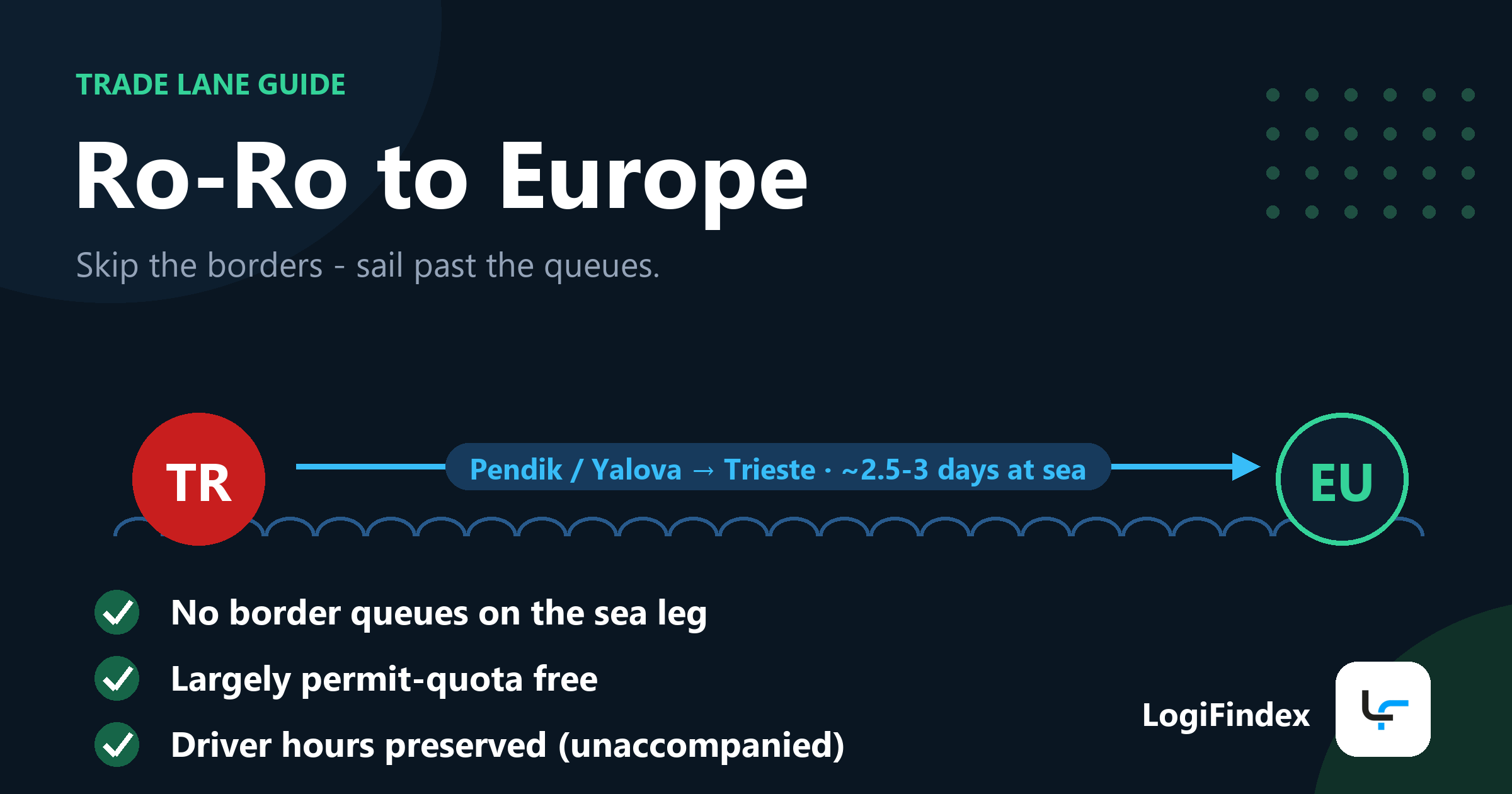
Ro-Ro (roll-on/roll-off) puts the trailer on a ship instead of driving it across six borders. On Türkiye-Europe lanes, trailers sail mainly from Pendik and Yalova to Trieste in Italy (and to Sète in France), then continue by road or rail inside the EU. It skips the Kapikule and Balkan queues and most transit-permit needs; in exchange it is schedule-bound and usually costs more than a quiet-season road run. The four situations where it wins: border congestion, permit-quota crunch, driver-time limits and southern-Europe deliveries.
Every time Kapikule makes the news, exporters rediscover the same word: Ro-Ro. This guide explains how it actually works, what it costs you in flexibility, and when the ship genuinely beats the road.
How Ro-Ro Works
The cargo unit is the trailer itself. It rolls onto the vessel at the departure port, crosses the sea, rolls off, and continues to the buyer. Two operating modes:
- Accompanied: the tractor and driver sail with the trailer. Simple, but you pay the driver’s sea days and cabin.
- Unaccompanied: only the trailer sails; a partner tractor picks it up at the arrival port. This is the dominant model on Türkiye-EU lanes - no driver time burned at sea, and one tractor at each end stays productive.
The Main Connections from Türkiye
| Departure | Arrival | Sea leg | Onward |
|---|---|---|---|
| Pendik / Yalova (Istanbul area) | Trieste (Italy) | ~2.5-3 days | Road or rail into IT/AT/DE/CH and beyond |
| Yalova | Sète (France) | ~3.5-4 days | Road into France and Iberia |
| Mersin | Trieste (Italy) | ~3-3.5 days | Same as above |
Operators such as DFDS run scheduled, multiple-weekly departures on these corridors; from Trieste, block trains carry unaccompanied trailers deeper into Central Europe. Frequencies and rotations change with the season - confirm the current schedule at quoting time rather than planning from memory.
These sea-leg durations are typical scheduled ranges as of September 2026. Add port cut-off, loading and pickup time at both ends when you plan door to door.
Ro-Ro vs the Balkan Corridor: the Honest Comparison
| Road (Balkan corridor) | Ro-Ro routing | |
|---|---|---|
| Istanbul → Munich, typical | 4-6 days | 5-7 days (Trieste + 530 km road) |
| Istanbul → Rotterdam, typical | 5-7 days | 6-8 days (Trieste + ~1,350 km) |
| Predictability | Border-dependent | High - sailing schedule |
| Transit permits | Bilateral quotas + UBAK | Largely avoided |
| Border queues | Kapikule + 4-5 crossings | None on the sea leg |
| Driver hours | Fully consumed | Preserved (unaccompanied) |
| Cost | Lower in quiet seasons | Usually higher; gap narrows when quotas bite |
| CO2 per tonne | Higher | Lower - a real reporting advantage |
The pattern: in a quiet month the road is faster and cheaper; in a congested or quota-tight month Ro-Ro is steadier and often cheaper in total once waiting days, permit scarcity and driver costs are priced in.
The Four Situations Where the Ship Wins
- Border congestion. When Kapikule waits stretch, the fixed sailing schedule beats the queue lottery - the Germany guide covers how quickly corridor times deteriorate.
- Permit-quota crunch. Bilateral transit permits are annual and finite. Late in the year, Ro-Ro capacity becomes the pressure valve for the whole market - book early, because everyone has the same idea.
- Driver-time limits. Unaccompanied trailers turn one driver shortage into two short shuttle jobs at either end.
- Southern-Europe deliveries. For Italy, southern France, Switzerland and southern Germany, the ship lands the trailer practically next door - Trieste to Milan is ~430 km, to Munich ~530 km. For these destinations Ro-Ro is not the fallback; it is often the primary route.
What to Watch (the Fine Print)
- Book the sailing, then the truck. In peak weeks vessel space sells out; a confirmed trailer with no slot waits at the port.
- Port cut-off discipline: miss the gate closing and you wait for the next departure - schedule risk cuts both ways.
- Trailer spec: unaccompanied trailers must be seaworthy-lashed; declare cargo that needs power (reefers) at booking.
- Insurance: the sea leg is a real sea voyage - check that your cargo policy covers it and read our ICC clause guide for what standard clauses exclude.
- Costs come itemized: sea freight + port charges at both ends + onward leg. Compare door-to-door totals, the same discipline as in our surcharges guide.
Conclusion: a Scheduled Bypass, Not a Silver Bullet
Ro-Ro is best understood as a paid bypass around borders, quotas and driver hours, with a timetable. When those three constraints are loose, the road wins; when they tighten, the ship does. Since the constraints change month to month, the only reliable answer is a current, side-by-side quote.
Publish your load once on LogiFindex and compare Balkan-corridor and Ro-Ro-routed offers on one screen - insurance and customs quotes included, 0% commission.