
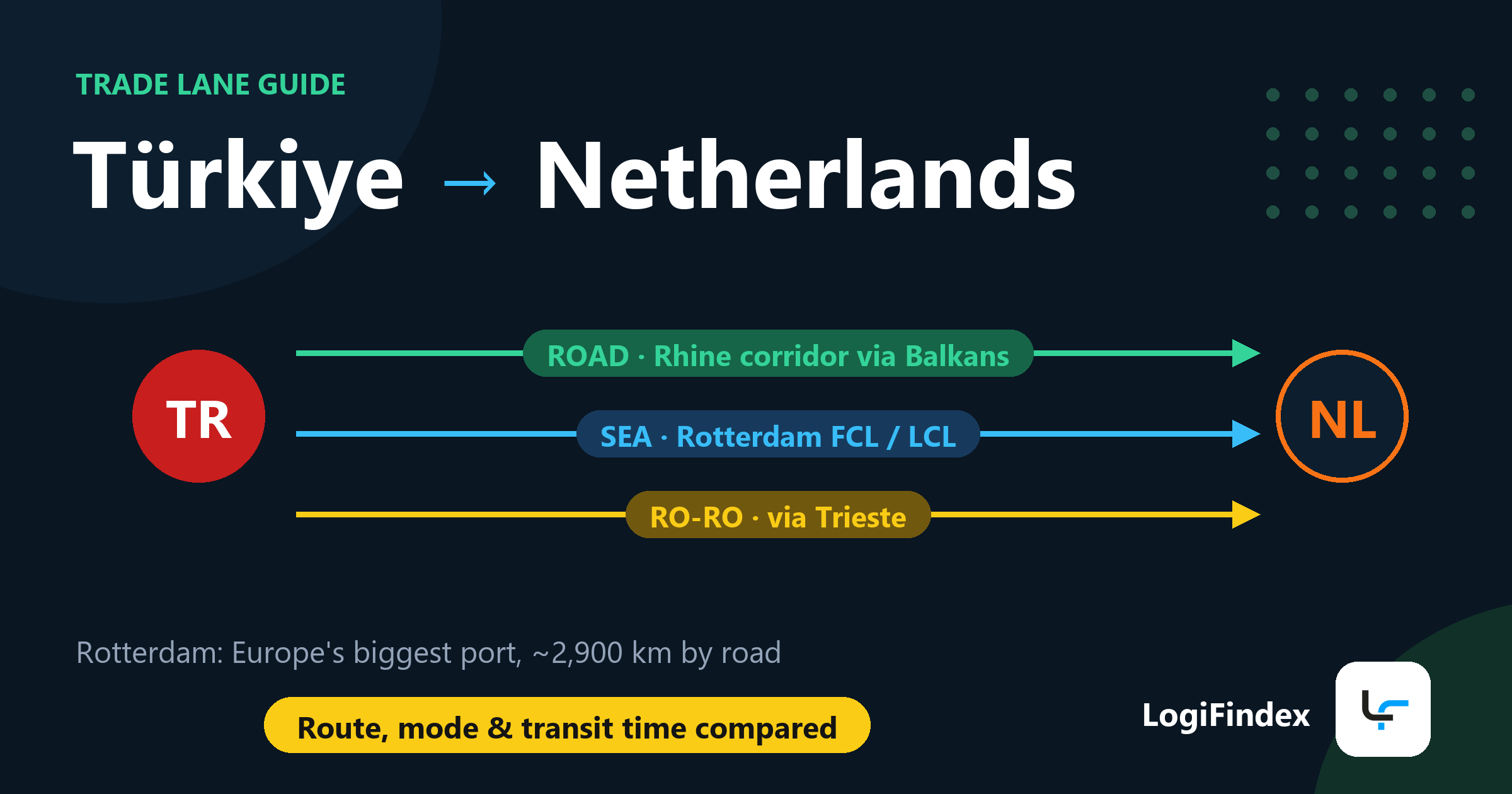
Freight moves between Türkiye and the Netherlands four main ways: road (the Balkan corridor into the Rhine valley), sea (container services into Rotterdam), a Ro-Ro-connected routing via Italy, and intermodal rail combinations. Road is fastest, sea is cheapest per volume, and Rotterdam’s hinterland network makes the Netherlands one of the easiest EU destinations to price well. The right choice depends on urgency, volume and where in the Benelux your buyer sits.
The Netherlands is consistently among Türkiye’s top export markets in the EU, and it punches above its weight in logistics: Rotterdam is Europe’s largest port, and a large share of Turkish cargo bound for Belgium, northern France and even western Germany clears through Dutch gateways.
For the exporter this means the same three things the Germany lane offers: many carriers competing, several routings, and wide spreads between quotes. This guide compares the options.
The Four Options Compared
| Road | Sea (Rotterdam) | Ro-Ro + road | Intermodal | |
|---|---|---|---|---|
| Speed | Fastest | Slowest | Medium | Medium |
| Cost | Higher | Lowest per volume | Between road and sea | Between road and sea |
| Best for | Urgent, mid volume, high value | Big volume, flexible dates | Border-queue seasons, quota crunch | Regular flows |
| Door to door | Direct | Port legs needed | Port + road leg | Terminal legs needed |
| Predictability | Depends on borders | High (scheduled) | High (scheduled) | High (scheduled) |
Transit Times: Typical Ranges by Routing
| Routing | Typical | Busy season |
|---|---|---|
| Istanbul → Rotterdam (road, Kapikule, ~2,900 km) | 5-7 days | 8-12 days |
| Pendik/Yalova → Trieste → Netherlands (Ro-Ro + ~1,350 km road) | 6-8 days | 8-10 days |
| Ambarli → Rotterdam (sea, FCL) | 13-19 days | 18-25 days |
| Ambarli → Rotterdam (sea, LCL) | 19-28 days | 26-36 days |
These are door-to-door field ranges as of September 2026, including driver rest, border waits and customs preparation. Rotterdam is often an early call on North Europe rotations, which is why FCL here can run slightly shorter than Hamburg on the same service.
Transit times move with season, border congestion, port situation and customs workload. Use this table as a scale; base planning on a current quote.
Road: the Balkan Corridor into the Rhine Valley
Exit at Kapikule or Hamzabeyli; then Bulgaria - Serbia - Hungary - Austria - Germany, entering the Netherlands past the Ruhr. Istanbul to Rotterdam is roughly 2,900 km of driving, about 300 km more than Hamburg.
The strengths and risks are the Germany lane’s, unchanged: direct and transshipment-free, but exposed to Kapikule and Balkan border queues, and to the annual quota system for bilateral transit permits (with UBAK/ECMT as the multilateral alternative). When quotas tighten, road capacity shrinks and prices rise - which is exactly when the Ro-Ro routing earns its keep. We covered the corridor mechanics in the Türkiye-Germany guide; everything there applies until the German-Dutch border.
Sea: Rotterdam Is the Easy Part - Price the Legs Around It
Regular container services connect Turkish ports (Ambarli, Gebze/Izmit, Izmir, Mersin) to Rotterdam, with both FCL and LCL options. Antwerp quotes will often appear alongside Rotterdam ones for the same cargo - for southern Netherlands deliveries they are genuinely interchangeable, so let them compete.
What makes the Netherlands special is what happens after the port: barge and rail shuttles run deep into the hinterland, and short truck legs cover most of the country - nowhere in the Netherlands is more than about 200 km from Rotterdam. That keeps post-port drayage cheap compared with, say, a Stuttgart delivery out of Hamburg.
Sea freight is port to port. Factory-to-port and port-to-buyer leg costs, terminal handling (THC) at both ends, destination local charges and demurrage risk come on top. Compare totals, not base freight - the full list of add-ons is in our freight surcharges guide.
Ro-Ro-Connected Routing
Trailers sail from Pendik or Yalova to Trieste in Italy (operators such as DFDS also serve Sète in France), then continue by road roughly 1,350 km north to the Netherlands. It skips the land-border queues entirely and reduces transit-permit needs.
For Benelux specifically, the after-sea road leg is longer than it is for southern Germany, so the routing pays off mainly in three situations: heavy border congestion, permit-quota crunch, or driver-time constraints. Full mechanics, schedules and the accompanied/unaccompanied distinction are in our Ro-Ro guide.
A real reference point: LogiFindex’s cost-based market indication for Istanbul → Rotterdam FTL road stands at roughly €3,100 - €4,200 as of September 2026. It is an estimate, not a quote - but it tells you instantly whether an offer is in the realistic band.
Where in the Benelux Is Your Buyer?
- Rotterdam / Randstad (Amsterdam, Utrecht, The Hague): the port is on the doorstep - sea is at its strongest here.
- Southern Netherlands and Flanders (Eindhoven, Tilburg, Antwerp): Rotterdam and Antwerp services compete head to head; ask for both.
- Buyer takes delivery inland (Venlo, Duisburg direction): barge and rail shuttles from Rotterdam are worth pricing - Venlo is one of Europe’s biggest intermodal hubs.
Simple rule: quote door to door. In the Netherlands the port-to-door legs are short and cheap, which is precisely why sea wins here more often than on the Germany lane.
Three Scenarios by Sector
Fresh and dry food (Izmir → Rotterdam food importers). Weekly pallets, shelf-life pressure. Choice: road groupage for speed, reefer FTL if temperature-controlled; sea FCL for dry bulk runs with flexible dates.
Textiles (Istanbul → Tilburg wholesalers). 5-10 pallets weekly, steady flow. Choice: road groupage; regularity earns discounts. Hanging-garment trailers must be requested explicitly.
Furniture and homeware (Inegol → Dutch retail chains). Bulky, low value per kg, flexible schedule. Choice: 40' High Cube FCL to Rotterdam plus a short drayage leg - the classic case where sea wins outright.
Customs: A.TR Works the Same Way
The Netherlands is an EU member, so industrial goods under the EU-Türkiye Customs Union travel with an A.TR movement certificate and enter duty-free; agricultural and coal-steel products use EUR.1 instead. The document mechanics - who issues it, MEDOS approval, the 4-month validity - are identical to the Germany lane and are covered in detail there. One Dutch-specific note: Rotterdam customs works heavily with pre-lodged declarations - make sure your forwarder files before the vessel arrives, not after.
For the buyer-side EORI question (who needs it, what DDP does to you), see the EORI guide.
Pre-Departure Document Checklist
- Commercial invoice (English, Incoterm stated)
- Packing list
- A.TR (industrial goods) or EUR.1 (agriculture/coal-steel)
- CMR (road) or bill of lading (sea)
- Export customs declaration
- Certificate of origin if required
- Insurance policy (mandatory under CIF/CIP, advisable otherwise)
Price all modes at once. Publish your load once on LogiFindex and compare road, sea and alternative-routing quotes side by side - customs broker and insurance quotes arrive on the same file, 0% commission.