
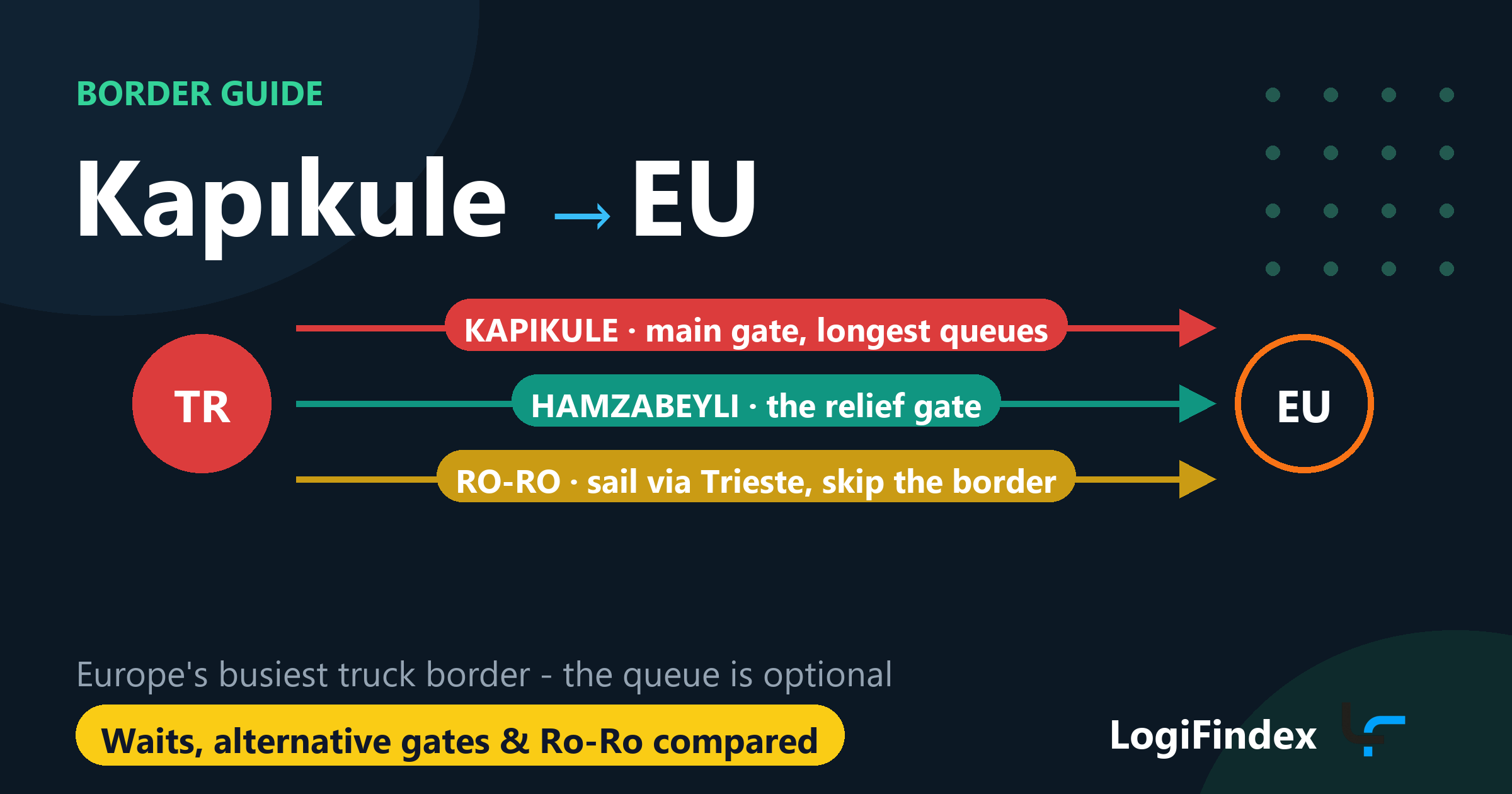
Kapıkule is mainland Europe's busiest land border gate for trucks, and waiting times there are structurally volatile: a quiet day clears in hours, a congested week costs 2-3 days per direction. The costs are real - driver time, missed delivery windows, spoiled schedules - but they are manageable: watch queue reports before loading, keep the crossing flexible, pre-lodge declarations, and keep a Ro-Ro fallback for the worst weeks.
Every exporter who ships Türkiye-EU by road has lived this phone call: "the truck is at the border." Not moving, not lost - just waiting. This guide explains why the queue forms, what it really costs you, and the four practical ways around it.
Why Does the Queue Form at All?
Türkiye is outside the EU customs union's border-free zone, so every single truck is processed individually at the EU's edge: Turkish exit formalities, then Bulgarian (EU) entry - documents, weighbridge, X-ray or physical checks where selected. Two sovereign processes, back to back, on a lane that carries a huge share of Türkiye's roughly 56 billion dollars of annual exports to the EU.
The queue breathes with predictable rhythms:
- Seasonality: pre-holiday weeks (both Turkish religious holidays and European Christmas), harvest season and the year-end shipping rush all spike volumes.
- Transit permit pressure: late in the year, bilateral transit permits for some corridor countries run scarce, concentrating trucks on particular routes and days.
- One-off shocks: a customs IT outage, a strike on the Bulgarian side, new inspection campaigns. These are unannounced and explain why "how long is the wait" has no fixed answer.
Be sceptical of any fixed number for the wait. The honest answer is "check this week's queue report". In Türkiye, carriers and the international transporters' association publish regular border situation updates; a good forwarder watches them daily. Ask yours for the current picture before you fix a loading date - it is a one-line WhatsApp message.
What the Wait Actually Costs
A truck standing still is not free. Three meters are running:
- Vehicle and driver cost: a tractor-trailer with driver costs real money per day whether it moves or not. Carriers price expected border time into the freight; in bad periods they add explicit waiting surcharges.
- Driving-time rules: EU rules cap driver hours. A long queue can push the driver into a mandatory rest exactly when the barrier finally opens - turning a 30-hour delay into 40.
- Your delivery window: the quiet killer. A missed slot at a German retailer's warehouse can mean rebooking days later, and for production-line parts the downstream cost dwarfs the freight itself.
Practical rule: on Türkiye-EU road moves, quote your buyer a transit window, not a date - and build one buffer day per border into any commitment that carries a penalty.
The Alternatives, One by One
Hamzabeyli (to Bulgaria, via Lesovo). Kapıkule's pressure valve, some 50 km to the north-east. Truck-oriented, and often meaningfully quieter when Kapıkule spikes - which is exactly why authorities periodically steer TIR traffic there. The route beyond is the same Balkan corridor. If your transport order names only "Kapıkule", fix that today: give the carrier crossing flexibility.
İpsala (to Greece, via Kipi). The southern option, entering the EU through Greece. It serves Greek and Italian destinations naturally (ferry connections from Greek ports toward Italy), and it is an EU entry like any other for A.TR purposes. For central-European destinations the routing is longer, so it is a relief route rather than a default.
Dereköy (to Bulgaria, via Malko Tarnovo). Exists, but capacity for heavy freight traffic is limited - think of it as a tactical option your carrier may use, not one to plan around.
Ro-Ro: skip the land border entirely. Trailers sail from Pendik, Yalova or Çeşme to Trieste (Italy) or Sète (France), then run the short road leg into central Europe. No Kapıkule, fewer transit permits, driver hours preserved - the full comparison, including accompanied vs unaccompanied trailers, is in our Ro-Ro guide. This is the structural answer when border congestion becomes chronic rather than episodic.
When Does Each Option Win?
- Normal weeks: Kapıkule or Hamzabeyli, whichever report looks cleaner. Pre-lodged declarations, flexible crossing clause, done.
- Peak season (November-December, pre-holiday): book earlier, buffer deliveries, and ask for a Ro-Ro quote alongside road - the ferry's fixed schedule becomes an advantage when queues are measured in days. The year-end dynamics are part of our Q4 2026 freight outlook.
- Permit-scarce lanes and driver-hour crunches: unaccompanied Ro-Ro - the trailer sails without the tractor, sidestepping both constraints at once.
- Greece / Italy destinations: İpsala merits a permanent look, not just a congestion fallback.
The Paperwork That Prevents Self-Inflicted Queues
A share of every border queue is trucks that were not ready: export declaration mismatches, missing transit documents, A.TR forms issued late. The border you can control is the one inside your own file. Our checklist logic is simple: declarations pre-lodged before arrival, invoice and packing list consistent to the kilogram, A.TR or EUR.1 in the driver's folder, and the buyer's EORI number confirmed for EU entry. The seven most common customs blockers - border and inland - are dissected in why your cargo gets stuck at customs.
Compare routes, not just prices. Post your load once on LogiFindex and collect quotes from carriers running Kapıkule, Hamzabeyli and Ro-Ro routings side by side - with customs brokers and cargo insurers on the same screen, at 0% commission.